

Who Was Zhong Kui? The Scholar Who Became a Ghost Hunter
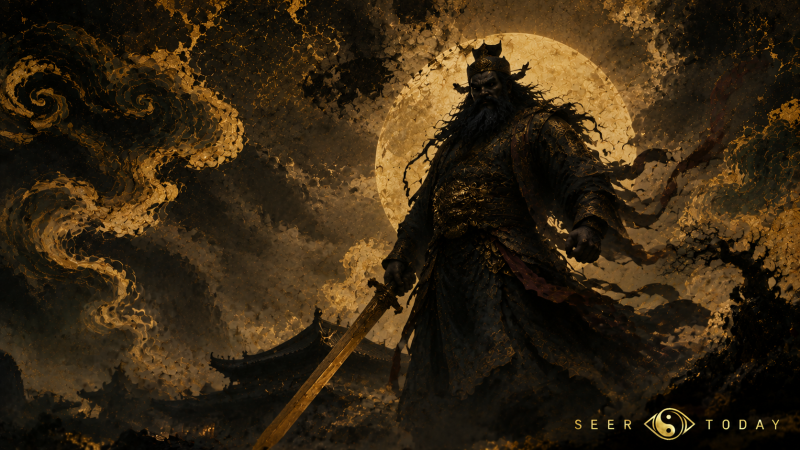
Zhong Kui (钟馗) is one of the most recognizable figures in Chinese folk religion and Taoist iconography — a fierce, bearded man with bulging eyes, wielding a peach wood sword, often depicted trampling a demon underfoot. His image hangs above doorways across China, Taiwan, and Southeast Asia, particularly during the Dragon Boat Festival and Lunar New Year, where he serves as a protective guardian against evil spirits.
But Zhong Kui was not always a deity. According to the most widely accepted version of his story, he was a real man — a brilliant scholar from the Zhongnan Mountains (终南山) who lived during the Tang Dynasty (618–907 CE). His transformation from mortal scholar to ghost-hunting deity is one of the most poignant and culturally significant narratives in Chinese folklore, blending themes of justice, grief, redemption, and the enduring belief that personal suffering can be transmuted into protective power.
The Legend: Death, Honor, and a Vow of Protection
Zhong Kui traveled to the Tang capital of Chang'an (modern Xi'an) to sit for the imperial examination — the highest academic honor in imperial China. He was exceptionally gifted. By all accounts, his essays were brilliant, and he should have placed first in the entire empire.
When the results were announced, Zhong Kui had indeed scored first. But when he was presented to Emperor Xuanzong (唐玄宗), the emperor took one look at his face — described in historical sources as dark-skinned, with a heavy brow, protruding eyes, and a thick beard — and recoiled. Despite his academic achievement, the emperor refused to award the top honor to someone he considered physically repulsive.
The court officials, following the emperor's lead, withdrew the appointment. In utter despair and humiliation — having been denied the life's achievement he had earned solely because of his appearance — Zhong Kui threw himself against the palace steps and died.
Emperor Xuanzong, learning the full story of what had transpired, was moved by grief and regret. He ordered that Zhong Kui be buried with the full honors due to the top examination graduate, posthumously granting him the title "King of Ghosts" (驱鬼帝君 / Qu Gui Di Jun) and decreeing that he be honored as a guardian spirit of the realm.
Zhong Kui's spirit, grateful for this posthumous recognition, is said to have vowed to protect the living from all manner of ghosts, demons, and malevolent entities for as long as the empire endured.
There is a second, equally compelling layer to the legend. Shortly after Zhong Kui's death, Emperor Xuanzong fell gravely ill with a fever. In his delirium, he dreamed that a small demon was stealing a jade flute from his bedside. As the demon attempted to flee, a large, fierce figure appeared — a man with a beard and glaring eyes, dressed in the robes of a scholar but carrying a sword of peach wood. The figure seized the demon, tore it apart with his bare hands, and devoured it.
When the emperor asked the figure's identity, the man replied: "I am Zhong Kui, the examination graduate who died on the palace steps. I have returned to repay the honor you showed me."
The emperor awoke. His fever had broken. He summoned the court painter Wu Daozi (吴道子) — one of the greatest artists of the Tang Dynasty — and described the figure from his dream. Wu Daozi painted Zhong Kui exactly as the emperor described. The painting became the canonical image of Zhong Kui, distributed and reproduced across the empire.
Iconography: How to Recognize Zhong Kui
Zhong Kui's iconography is remarkably consistent across centuries of Chinese art. Once you learn to recognize him, you will see his image everywhere in Chinese cultural settings — on scroll paintings, door posters, porcelain, wood carvings, and protective amulets.
The standard depiction includes:
- A fierce, bearded face with bulging, glaring eyes: The intensity of his gaze is said to terrify evil spirits, who cannot bear to be seen by him. His expression is not anger — it is righteous authority.
- Scholar's robes and an official's hat: These signify his scholarly achievement and the imperial honor granted to him posthumously. He is not a warrior in armor. He is an intellectual who was wronged and returned with a purpose.
- A peach wood sword (桃木剑 / Tao Mu Jian): This is perhaps the most important detail. Zhong Kui's sword is specifically made of peach wood — no other material will do. Peach wood is the only wood in Taoist tradition believed to possess innate Yang energy capable of repelling Yin-based entities. The sword symbolizes righteous authority cutting through spiritual obstruction.
- A demon or ghost subdued beneath his foot: This represents his ongoing mission — the conquest of evil. The demon is often depicted as small, pathetic, and cowering, emphasizing the power imbalance between Zhong Kui's righteous Yang energy and the diminished Yin energy of malevolent spirits.
- Sometimes accompanied by bats (蝠 / Fu): In Chinese visual culture, the bat is a homophone for "good fortune" (福 / Fu). Five bats represent the Five Blessings (五福 / Wu Fu): longevity, wealth, health, love of virtue, and natural death. Zhong Kui's association with bats links his protective function to the attraction of good fortune — not just the repulsion of evil.
Zhong Kui in Taoist Practice and Folk Religion
Zhong Kui occupies a fascinating position in Chinese spiritual practice. He is not strictly a Taoist deity in the sense of being part of the formal Taoist pantheon. He originated in folk religion and was later absorbed into Taoist practice because his protective function aligned perfectly with Taoist exorcism rituals.
In Taoist temples, Zhong Kui is often invoked during rituals for house cleansing, exorcism, and the removal of spiritual obstacles. Taoist priests may burn talismanic paper bearing his image or chant his name while wielding a peach wood sword — mirroring the iconography of the deity they are invoking.
In folk practice, Zhong Kui's image is most commonly used in three ways:
- Door posters (门神画 / Men Shen Hua): Printed images of Zhong Kui are pasted on doors during the Dragon Boat Festival (端午节 / Duan Wu Jie) — the fifth day of the fifth lunar month, which is considered the most Yang day of the year, when protective rituals are most potent. The posters remain in place year-round in many households.
- Personal amulets and pendants: Small carved or cast images of Zhong Kui are worn as protective charms. These are particularly common for people working in professions associated with night shifts, travel, or exposure to uncertain environments.
- Hanging scrolls: Paintings of Zhong Kui subduing demons are hung in homes and businesses, especially in entryways, to establish a protective presence at the threshold.
Why Zhong Kui Matters Now
The enduring appeal of Zhong Kui is not just about ghost stories. At a deeper level, his legend addresses universal human concerns that remain as relevant now as they were in the Tang Dynasty.
Zhong Kui is an outsider who was rejected for something he could not change about himself. He was judged unfairly by a system that should have rewarded his merit. And yet, instead of fading into obscurity, he returned — transformed, empowered, and dedicated to protecting others from harm. His story is not about revenge. It is about transmutation: turning personal tragedy into a force that benefits others.
This is why his image has resonated for over 1,300 years. People hang Zhong Kui on their doors not just because they believe in ghosts, but because the symbolism is powerful: the brilliant scholar who was cast out, who came back not to destroy the world that rejected him but to protect it. That is a story worth telling.
Related Protection Collections
- Taoist Talismans — Consecrated protective amulets and charms, including Zhong Kui talismans and Five Thunder talismans.
- Peach Wood Protection Charms — Peach wood pendants and charms, the traditional material of Zhong Kui's protective sword.
Recommended Protection Pieces
- Thunder Command Jujube Wood Charm — A hand-carved Taoist protective amulet with Shangui coin, embodying the commanding protective energy associated with Zhong Kui.
- The Night Ward Cinnabar & Peach Wood Bracelet — Combines peach wood beads with cinnabar — the material of Zhong Kui's sword paired with the protective ink of Taoist talismans.
Continue Reading: Taoist Protection Deep Dives
- Taoist Protective Amulets & Talismans: A Complete Guide — Types, materials, traditions, and how to choose an authentic protective amulet.
- Peach Wood Protection Meaning — The 3,000-year history of Tao Mu — the wood of Zhong Kui's sword.
- The Logic of Taoist Evil-Warding — Dao, Yin Yang, Jing Qi Shen and the philosophical framework of protection.
- Divinely Blessed Wood: Lei Ji Mu Guide — Why lightning-struck wood is the ultimate protective material in Taoist tradition.
- What Is the Bagua? Meaning, Protection Symbolism and Taoist Origins — The eight trigrams and their role in Taoist protection.
Quick Answer
Zhong Kui is the legendary ghost-hunting deity of Chinese folk religion and Taoism — a brilliant Tang Dynasty scholar who was unjustly denied the imperial examination honor due to his appearance. After his death, he was posthumously honored and vowed to protect the living from evil spirits, becoming the most iconic symbol of protective authority in Chinese spiritual culture.
Questions This Guide Answers
- Who was Zhong Kui as a historical figure and how did he become a deity?
- What is the full story of Zhong Kui and Emperor Xuanzong's dream?
- How do you recognize Zhong Kui in Chinese art and iconography?
- Why does Zhong Kui carry a peach wood sword specifically?
- How is Zhong Kui used in Taoist practice and folk protection today?
Reader Note
Seer articles explain cultural symbolism and spiritual traditions for general learning. They are not medical, financial, or legal advice. Spiritual objects and cultural accessories are offered for personal intention, reflection, and appreciation of tradition.
Leave a comment