

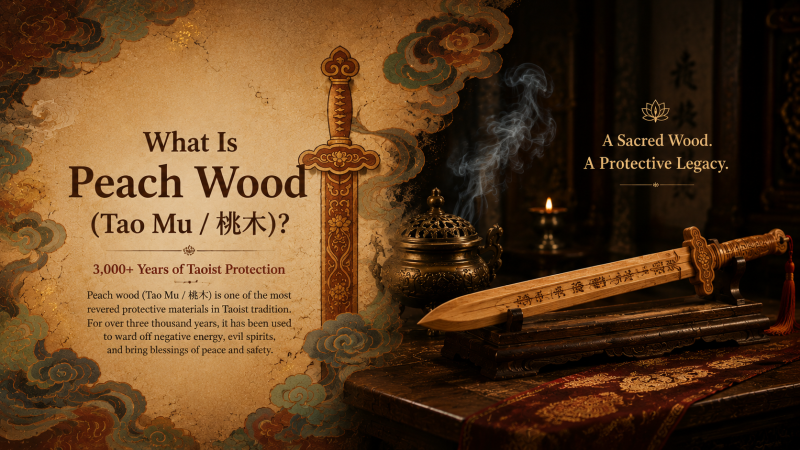
What Is Peach Wood (Tao Mu / 桃木)?
Peach wood — Tao Mu (桃木) in Chinese — is exactly what it sounds like: wood from the peach tree (Prunus persica). But in the context of Taoist protection, it is far more than lumber. For over three thousand years, peach wood has been the material of choice for protective charms, amulets, and ritual tools across Chinese spiritual practice.
Unlike other woods valued primarily for their grain, density, or workability, peach wood carries a specific symbolic weight. It is the only wood consistently described in classical Taoist texts as possessing innate Yang (阳) energy — the active, bright, protective force that naturally repels Yin (阴) influences. This is not a recent folk belief. It is documented in texts dating to the Western Zhou Dynasty (1046–771 BCE).
When you hold a well-made peach wood charm, you are holding a material that Chinese civilization has trusted for protection longer than most world religions have existed.
The 3,000-Year History of Peach Wood Protection
The earliest written record of peach wood used for protective purposes appears in the Zhou Li (周礼 / Rites of Zhou), a text compiled during the Zhou Dynasty that describes state rituals and customs. It mentions that during the Lunar New Year, households would hang peach wood boards — known as Tao Fu (桃符) — on their gates to prevent malevolent spirits from entering.
This practice was not metaphorical. The Zhou-era Chinese believed that harmful spirits and unsettled ghosts moved in straight lines and could not pass through thresholds protected by peach wood. The boards were inscribed with the names of Shen Tu (神荼) and Yu Lei (郁垒), two guardian deities tasked with subduing ghosts.
By the Han Dynasty (206 BCE–220 CE), the practice had become widespread. Peach wood charms were no longer just for gates — they were carved into small personal amulets, hung from belts, and placed under pillows. Wang Chong, a Han-era philosopher, recorded in his Lun Heng (论衡) that "peach wood is the essence of the five woods, and therefore it subdues evil."
The Tang Dynasty (618–907 CE) saw peach wood protection reach its most elaborate form, with intricately carved peach wood swords becoming standard equipment for Taoist priests performing exorcism rituals. It was during this period that peach wood became permanently associated with Zhong Kui (钟馗), the legendary ghost-hunting deity.
Zhong Kui and the Peach Wood Sword
If there is one figure who embodies the protective power of peach wood, it is Zhong Kui. According to folklore, Zhong Kui was a brilliant scholar during the Tang Dynasty who traveled to the capital to take the imperial examination. Despite scoring first in the examination, the emperor rejected him because of his ugly appearance. In despair, Zhong Kui took his own life on the palace steps.
The emperor, learning of the injustice, honored him posthumously with the title "King of Ghosts" and ordered him buried with full honors. In gratitude, Zhong Kui's spirit vowed to protect the realm from all manner of ghosts and malevolent entities.
Zhong Kui is traditionally depicted wielding a sword made of peach wood — specifically peach wood, no other material will do in the canonical iconography. Why peach wood? Because it combines two essential qualities: it is Yang in nature (actively protective) and associated with immortality through the Peaches of Immortality that grow in the garden of Xi Wang Mu (西王母), the Queen Mother of the West.
Images of Zhong Kui, often painted on peach wood panels, are hung in homes and businesses across China to this day — especially during the Dragon Boat Festival and Lunar New Year — as protective talismans.
Why Peach Wood? The Symbolism
The protective reputation of peach wood is not arbitrary. It rests on four interconnected symbolic pillars:
1. Yang Energy (阳)
In Taoist cosmology, the universe operates through the interplay of Yin (阴 / receptive, dark, passive) and Yang (阳 / active, bright, protective). Peach wood is classified as a Yang material because the peach tree blossoms in early spring — the season of Yang ascendance — and produces fruit associated with vitality and longevity. Protective magic in the Taoist tradition works primarily through Yang energy, which naturally repels Yin-based disturbances.
2. Immortality Resonance
The Peaches of Immortality (仙桃 / Xian Tao) grow in the heavenly orchard of Xi Wang Mu and ripen only once every three thousand years. Eating one grants eternal life. This mythological association means that peach wood is seen as carrying a subtle resonance with the immortal realm — making it an effective medium for protective talismans that invoke divine authority.
3. Spring and Renewal
Peach trees are among the first to blossom in the Chinese agricultural calendar, making them symbols of renewal, vitality, and the triumph of life over the dormancy of winter. Protective charms made from peach wood are believed to carry this renewing energy, constantly refreshing their protective field.
4. Five Woods Primacy
As Wang Chong noted in the Han Dynasty, peach wood is considered the "essence of the five woods" — the Five Elements (Wu Xing / 五行) applied to forestry. This makes it uniquely balanced and effective as a protective medium, containing within it the full spectrum of elemental energies.
How Peach Wood Charms Are Made
Traditional peach wood charm production follows specific guidelines that have been passed down through artisan lineages, though practices vary by region and master:
Wood Selection:
The most valued peach wood comes from older trees — ideally thirty years or more — that have grown naturally without heavy pruning. Wood from trees struck by lightning is considered especially powerful (this is Lei Ji Mu / 雷击木, a concept explored in depth in our lightning-struck wood guide). The wood must be harvested in winter when the sap is dormant, ensuring the carved charm will not crack over time.
Carving:
Hand carving is strongly preferred over machine cutting. The belief is that the carver's focused intention — their Yi (意) — is transferred into the wood during the carving process. A machine-cut peach wood charm is not considered energetically inert, but it is considered incomplete. The most common carved forms are abstract sword shapes, Bagua (Eight Trigrams) patterns, stylized Zhong Kui faces, and simple rectangular boards.
Peach Wood vs Other Protective Woods
Peach wood is not the only wood used in Taoist protection. Two others deserve mention because they often appear alongside it and because understanding the differences helps clarify peach wood's specific role:
Jujube Wood (枣木 / Zao Mu):
Jujube wood is harder and denser than peach wood and is often used for charms that need to survive outdoor exposure or heavy handling. In Taoist practice, jujube wood is associated more with "commanding" energy — the Five Thunder Talisman (五雷符) carved into jujube wood is considered especially potent. Our Thunder Command Jujube Wood Charm represents this tradition.
Lightning-Struck Wood (雷击木 / Lei Ji Mu):
When any tree — peach, jujube, or otherwise — is struck by lightning and survives, its wood becomes Lei Ji Mu, the most powerful protective wood in the Taoist hierarchy. Lightning is considered the ultimate Yang force — direct celestial intervention. Lei Ji Mu combines the inherent properties of the tree species with the added power of having been touched by Heaven's fire.
Peach wood occupies a unique middle ground: more accessible and affordable than Lei Ji Mu, warmer and more symbolically rich than jujube wood, and deeply embedded in Chinese folk tradition in a way that no other protective wood can claim.
How to Use and Care for a Peach Wood Charm
Using a peach wood charm is straightforward, but a few traditional guidelines help maintain its symbolic integrity:
- Wear it close to the body: Peach wood pendants and charms are designed to be worn against the skin or under clothing, where they maintain continuous contact with your personal energy field.
- Keep it dry: Unfinished wood absorbs moisture. Remove your peach wood charm before swimming or showering.
- Do not place it on the floor or in bathrooms: This is a general Taoist guideline for all protective objects.
- Remove during sleep: Taoist practice considers sleep a time when your energy field is naturally open.
- Recharge during the Lunar New Year: It is traditional to expose peach wood charms to the first sunrise of the new lunar year, renewing the Yang energy within the wood.
- If it cracks, replace it: A cracked charm is considered to have absorbed negative energy. Thank it and replace it. Do not throw it casually in the trash.
Related Protection Collections
- Peach Wood Protection Charms — Hand-carved peach wood and jujube wood Taoist amulets, pendants, and protective charms.
Recommended Protection Pieces
- Thunder Command Jujube Wood Charm — A hand-carved Taoist protective amulet with Shangui coin, embodying the Thunder Command tradition in jujube wood.
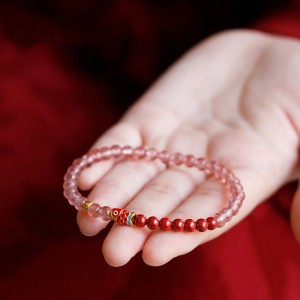
- The Night Ward Cinnabar & Peach Wood Bracelet — Combines peach wood beads with cinnabar, uniting two of the most historically significant protective materials in Chinese tradition.
Continue Reading: Taoist Protection Deep Dives
- Taoist Protective Amulets & Talismans: A Complete Guide — Types, materials, traditions, and how to choose an authentic protective amulet.
- Divinely Blessed Wood: Lei Ji Mu Guide — Why lightning-struck wood is considered the ultimate protective material in Taoist tradition.
- The Logic of Taoist Evil-Warding — Dao, Yin Yang, Jing Qi Shen and the philosophical framework of protection.
- Why Cinnabar Works for Warding Off Evil — The history, meaning, and science behind cinnabar in Taoist protective jewelry.
Quick Answer
Discover why peach wood has been used for Taoist protection for over 3,000 years — from Zhou Dynasty gate boards to modern hand-carved charms. Learn the symbolism, history, and traditional use of the most revered protective wood in Chinese spiritual practice.
Questions This Guide Answers
- What is peach wood and why does Taoist tradition consider it protective?
- How has peach wood been used for spiritual protection across Chinese history?
- What is the connection between Zhong Kui and the peach wood sword?
- How do I choose, use, and care for a peach wood protective charm?
- How does peach wood compare to jujube wood and lightning-struck wood?
Reader Note
Seer articles explain cultural symbolism and spiritual traditions for general learning. They are not medical, financial, or legal advice. Spiritual objects and cultural accessories are offered for personal intention, reflection, and appreciation of tradition.
Leave a comment