

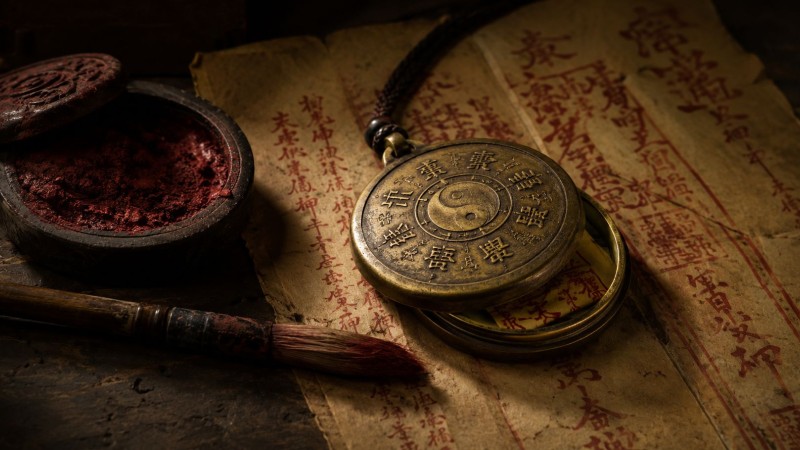
I first held a Taoist amulet in a small temple shop in Taipei about ten years ago. It was a tiny thing — a brass case no bigger than my thumbnail, worn smooth at the edges, with a faded red cord. Inside, the shopkeeper told me, was a paper talisman written in cinnabar ink by a Taoist priest from the nearby Lungshan Temple. He called it a Hu Shen Fu (护身符) — literally, a "body-protecting talisman."
I did not buy it. I did not understand what it was yet. But I never forgot how carefully the shopkeeper handled it, the way someone handles something they genuinely believe has power.
That is the thing about authentic Taoist amulets. They are not just jewelry. They are not just souvenirs. They are objects that someone, somewhere, took seriously enough to make properly. And that seriousness — that intention — is what has kept these traditions alive for over two thousand years.
What Exactly Is a Taoist Amulet?
Let me be precise about terms because the English word "amulet" gets thrown around loosely.
In Taoist practice, a Hu Shen Fu (护身符) is a consecrated protective object. It typically consists of:
- Fu (符): The talisman itself — a piece of yellow paper or cloth inscribed with Taoist script in cinnabar ink (Zhu Sha / 朱砂). These are not random symbols. Each stroke follows specific rules passed down through lineages. The characters often combine elements of standard Chinese writing with esoteric Taoist script — some recognizable, some deliberately altered to invoke spiritual authority.
- A protective case (符袋 / Fu Dai): Because paper talismans are fragile, they are housed in a small fabric pouch, a brass or silver locket, or sealed inside a wooden charm. The case protects the talisman from moisture and wear while allowing the wearer to keep it close to the body.
- Consecration (开光 / Kai Guang): A talisman is not considered "active" until it has been consecrated — a ritual typically performed by a Taoist priest (Daoshi / 道士) involving incense, invocation of deities, and the drawing of the talisman in a single uninterrupted session. This is not superstition to practitioners; it is a precise energetic procedure with defined steps.
The distinction matters because the market is flooded with printed, mass-produced "talismans" that have never been consecrated, never touched cinnabar ink, and were designed by graphic artists rather than anyone with Daoist training. These are decorations. They are not amulets in the traditional sense.
The Five Most Common Types of Taoist Protective Amulets
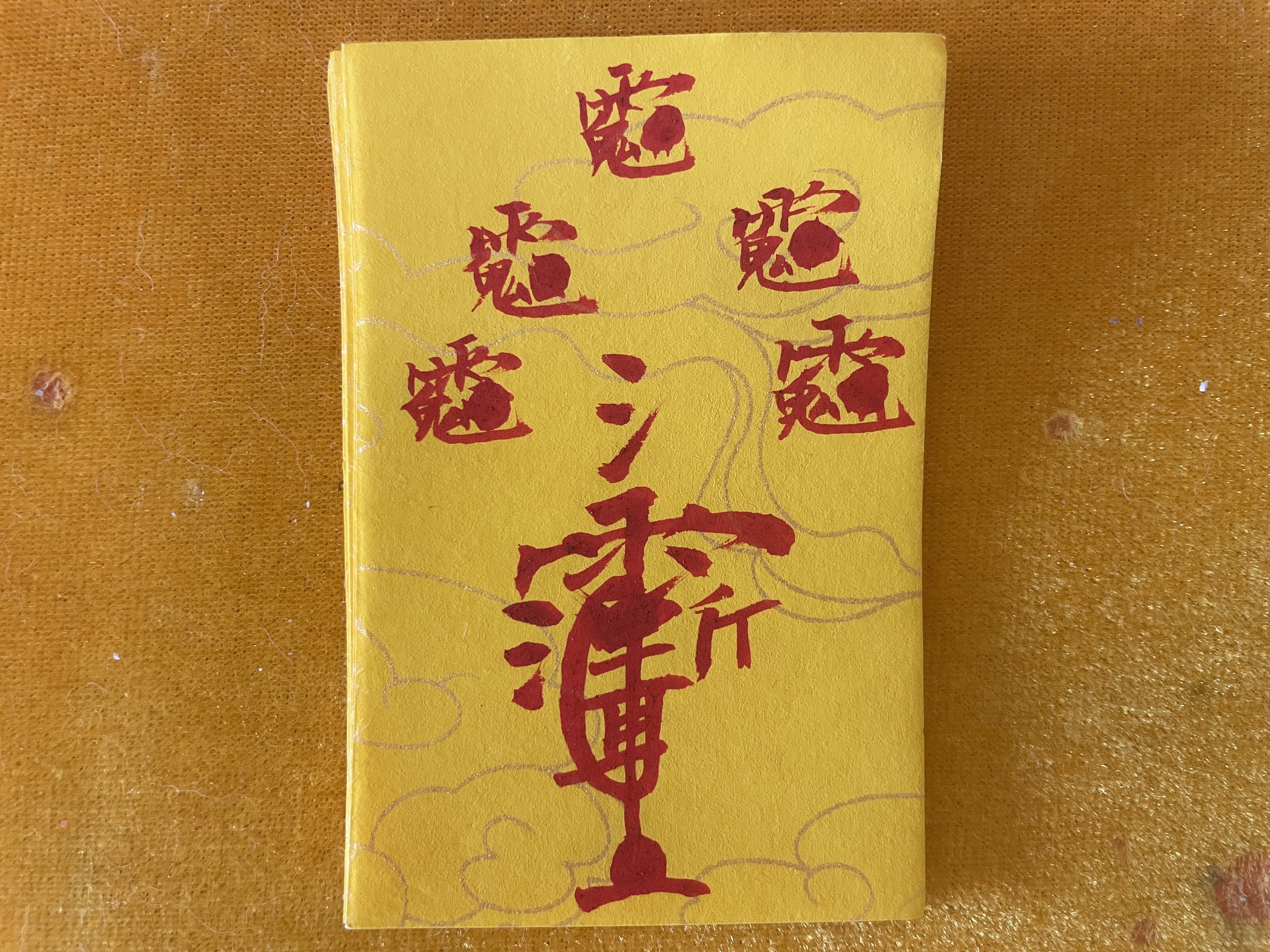
1. Five Thunder Talisman (五雷符 / Wu Lei Fu)
This is probably the most recognizable Taoist protective talisman. Its central element is the character for "thunder" (雷 / Lei), often written five times in a specific geometric arrangement, symbolizing the Five Thunder Gods (五雷神 / Wu Lei Shen) who command celestial lightning.
In Taoist cosmology, thunder is not just weather — it is the voice of Heaven, the force that dispels darkness and punishes evil. The Five Thunder Talisman channels this principle. You will see it used in home protection, personal amulets, and even automotive talismans hung from rearview mirrors in Taiwan and Southeast Asia.
Traditional materials: Yellow talisman paper, cinnabar ink, sometimes reinforced with a red ink paste made from cinnabar and alcohol. For wearable versions, the Fu is sealed inside a waterproof metal or wooden case.
What it looks like: Imagine a square of yellow paper with five bold, slightly asymmetrical "雷" characters arranged like points on a compass, connected by swirling lines that represent lightning bolts. The overall effect is intense and raw — nothing delicate about it.
2. Seven-Star Sword Talisman (七星剑符 / Qi Xing Jian Fu)
This talisman depicts the Big Dipper constellation (北斗七星 / Bei Dou Qi Xing) arranged as a sword. In Taoist star lore, the Big Dipper is not just stars — it is the celestial throne of Dou Mu (斗母), the Mother of the Big Dipper, a powerful Taoist deity. The seven stars aligned as a sword represent cosmic authority cutting through spiritual obstruction.
The Seven-Star Sword is particularly associated with Zhong Kui (钟馗), the legendary ghost-subduing deity. According to folklore, Zhong Kui was a talented scholar during the Tang Dynasty who was unfairly denied the top imperial examination rank because of his ugly appearance. In despair, he took his own life. The emperor, learning of the injustice, honored him posthumously — and Zhong Kui became the realm most feared ghost hunter, wielding a seven-star sword.
Worn as a pendant or carried in a pouch, the Seven-Star Sword talisman is traditionally given to people going through periods of vulnerability — illness, travel, major life transitions. It is a "cutting through" energy rather than a "shielding" energy, which is an important distinction in Taoist practice.
3. Bagua Talisman (八卦符 / Ba Gua Fu)
The Bagua (Eight Trigrams) is one of the oldest symbols in Chinese civilization, originating in the Yi Jing (I Ching / Book of Changes) over 3,000 years ago. In Taoist protective practice, the Bagua is typically arranged around a central mirror (八卦镜 / Bagua Jing), creating a powerful protective device.
The eight trigrams — Qian (乾 / Heaven), Kun (坤 / Earth), Zhen (震 / Thunder), Xun (巽 / Wind), Kan (坎 / Water), Li (离 / Fire), Gen (艮 / Mountain), and Dui (兑 / Lake) — represent the fundamental patterns of change in the universe. Arranged in the "Later Heaven" (后天八卦 / Hou Tian Bagua) sequence, they form a complete energetic shield.
Bagua talismans are most commonly used for home protection (hung above doors) and vehicle protection (hung from rearview mirrors). Personal wearable versions are usually smaller, engraved on wood or metal pendants.
Important: The Bagua mirror should face OUTWARD, away from your living space. Placing it incorrectly is considered energetically disruptive rather than protective.
5. Peach Wood Charms (桃木符 / Tao Mu Fu)
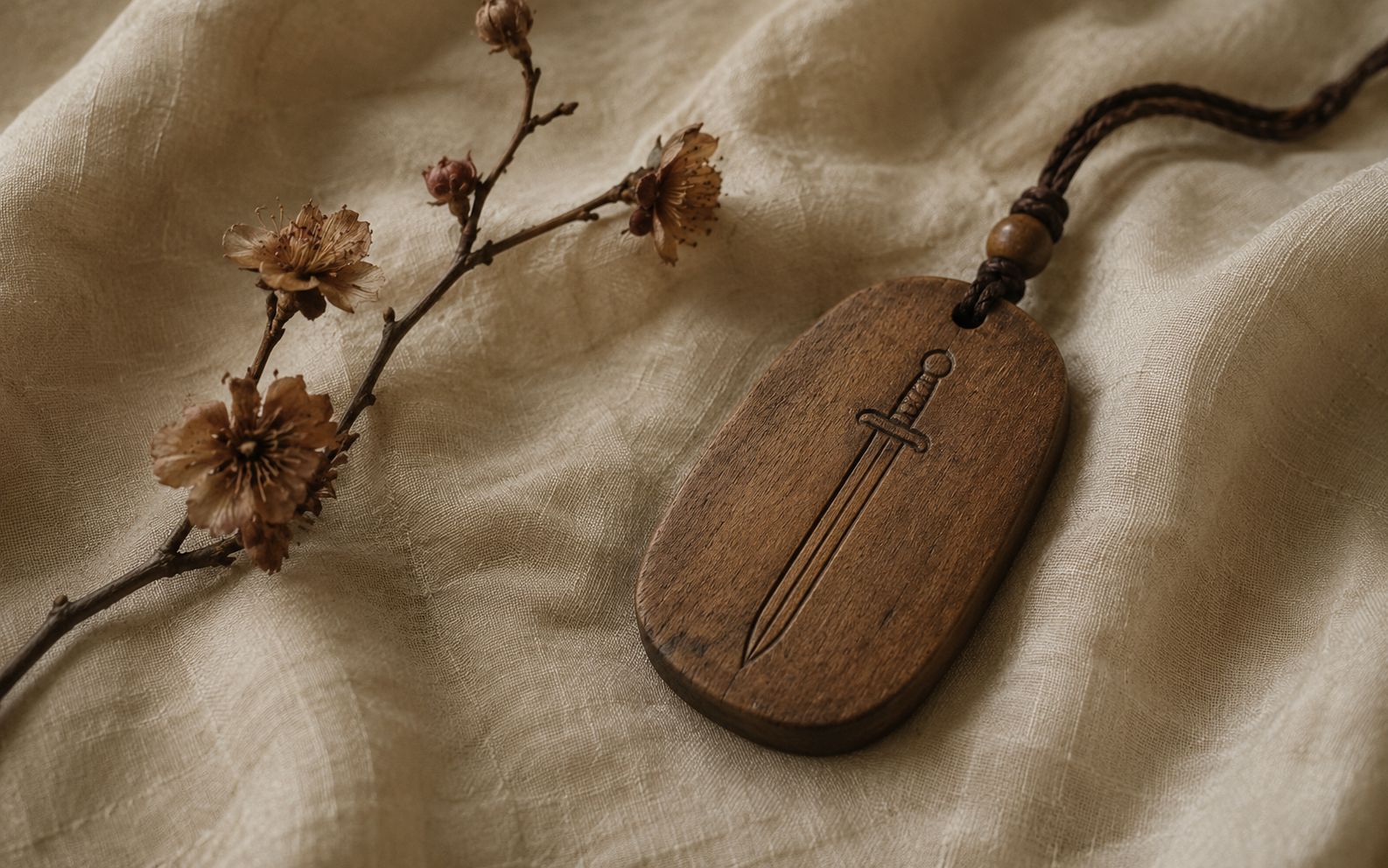
Peach wood (Tao Mu / 桃木) has been used for protective charms in China for at least 3,000 years, predating organized Taoism itself. The earliest written records of peach wood use come from the Zhou Dynasty (1046-256 BCE), describing how people hung peach wood boards on their doors during the New Year to ward off malevolent spirits.
In Taoist mythology, peach wood is the material of choice for Zhong Kui. The story goes that he carries a peach wood sword specifically — no other wood will do. Why peach? Because the peach tree is associated with immortality (the Peaches of Immortality grow in the garden of Xi Wang Mu, the Queen Mother of the West). Its wood carries both the protective Yang energy of a fruit-bearing tree and the immortal resonance of its mythological associations.
A well-made peach wood charm should be hand-carved, not machine-cut, and ideally from aged peach wood (older trees are considered to carry stronger protective energy). The carving is typically simple — abstract sword shapes, Bagua patterns, or Zhong Kui facial features.
How to Choose an Amulet: Purpose Over Aesthetics
Here is the most practical advice I can give: choose by function, not by how it looks.
A protective amulet is not a fashion accessory — though it can be beautiful. Its primary job is to do something. Before looking at anything, ask yourself what you actually need:
- Traveling? You want a Five Thunder or Seven-Star Sword — aggressive protection, "field" energy.
- Home protection? Bagua mirror or peach wood charm — stationary, environmental.
- Emotional vulnerability or grief? Six-Syllable Mantra — gentle, compassionate protection.
- General daily wear? A sealed Fu in a locket or pendant case — discreet, always with you.
- Gift for someone going through a hard time? Peach wood — warm, traditional, carries a sense of being cared for.
And please: avoid anything mass-produced that claims to be "consecrated." True consecration (Kai Guang) is an hours-long ritual performed by a trained Daoshi. It cannot be done in a factory. A talisman that was not consecrated is still meaningful as a cultural symbol — it just is not what it claims to be. Know the difference, and be at peace with whichever you choose.
How to Care for a Taoist Amulet
Treat it with respect. This is the only rule that matters.
- Keep it dry. Paper talismans will dissolve in moisture.
- Do not place it on the floor or in the bathroom. This is considered deeply disrespectful in Taoist practice.
- Remove it during intimate activities and sleep. These are times when your energy field is naturally open and the amulet protective function is either unnecessary or counterproductive.
- If the cord breaks or the case cracks, replace the cord or case. Do not throw the talisman in the trash. Old talismans are traditionally burned or buried with a word of thanks.
- Once a year, during the Lunar New Year, it is traditional to have your amulet "recharged" — either by a priest or by exposing it to the first sunrise of the new year.
One Last Thing
I want to address something honestly, because too many articles about Taoist amulets dance around it.
Does carrying a piece of yellow paper with red writing on it actually protect you from anything?
If you are asking this question in a purely materialist framework — does it create a measurable electromagnetic field that deflects physical harm — then no, there is no scientific evidence for that.
But here is what I have observed, over years of being around these objects and the people who wear them:
People who carry amulets move through the world differently. They feel accompanied. They feel less alone in difficult situations. That feeling — of being protected, of having something ancient and meaningful close to your body — changes how you walk, how you make decisions, what risks you take or do not take. That is not magic. That is psychology. But psychology is real, and its effects on your actual life outcomes are real too.
The Taoist sages understood this. They never claimed talismans worked by violating natural law. They claimed they worked by aligning your personal energy (Qi) with cosmic patterns (Dao). Whether you interpret that as metaphysics or metaphor, the practice has survived two millennia for a reason.
Explore Authentic Taoist Amulets: Browse Talismans & Protective Charms →
Recommended Protection Pieces
- Safe Passage Talisman Pouch — A handmade Taoist talisman pouch for personal protection during travel and daily life. The closest modern equivalent to the traditional Hu Shen Fu (护身符).
- Heavenly Lightning Seven-Star Sword Guardian Pendant — A Seven-Star Sword pendant in lightning-struck jujube wood, depicting the Big Dipper constellation as a protective sword — directly referenced in this guide.
Related Protection Collections
- Authentic Talismans — Consecrated Taoist protective amulets and charms, including Five Thunder, Seven-Star Sword, and Bagua talismans.
- Attract Protection — Jewelry and accessories for spiritual protection, warding off evil, and personal safety.
- Cinnabar Bracelets — Traditional Zhu Sha (朱砂) bracelets for protection, positive energy, and spiritual grounding.
- Divinely Blessed Wood — Lightning-struck wood (Lei Ji Mu / 雷击木) charms and accessories for powerful Taoist protection.
Continue Reading: Taoist Protection Deep Dives
- Spiritual Protection Mantra: Ward Off Evil — How Taoist mantras function as protective tools and how to use them effectively.
- The Logic of Taoist Evil-Warding: Dao, Yin Yang, Jing Qi Shen — The philosophical framework behind Taoist protective practices.
- Divinely Blessed Wood: Lei Ji Mu and Taoist Protection — Why lightning-struck wood is one of the most powerful protective materials in Taoist tradition.
- Why Cinnabar Works for Warding Off Evil — The history, meaning, and science behind cinnabar in Taoist protective jewelry.