
What Is the Bagua? Origins in Ancient China
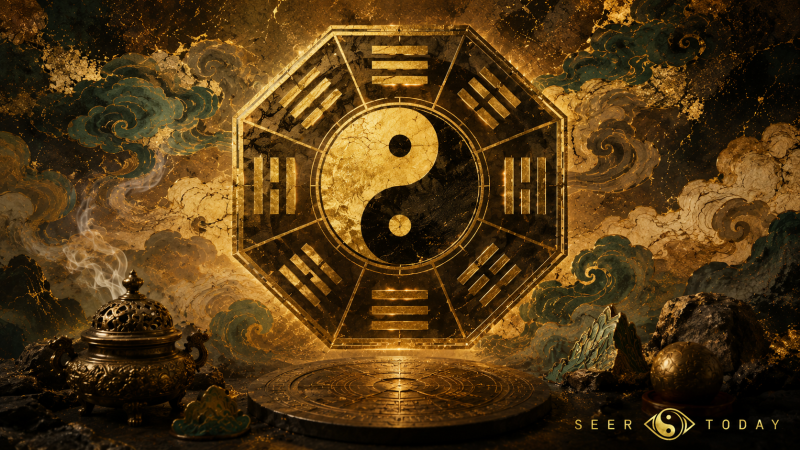
The Bagua (八卦 / Ba Gua) — literally "Eight Symbols" or "Eight Trigrams" — is one of the oldest and most influential diagrams in human civilization. Predating organized Taoism by centuries, it originated in the Yi Jing (易经 / I Ching or Book of Changes), a divination text whose earliest layers date to the Western Zhou Dynasty, approximately 3,000 years ago.
At its core, the Bagua is a system of eight three-line figures, each composed of broken (Yin / 阴) and unbroken (Yang / 阳) lines. These eight trigrams — Qian (乾), Kun (坤), Zhen (震), Xun (巽), Kan (坎), Li (离), Gen (艮), and Dui (兑) — represent the fundamental patterns of change in the universe. They are not arbitrary symbols. Each trigram corresponds to a specific natural element, direction, family member, body part, and energetic quality, forming a complete map of how energy moves through the physical and metaphysical worlds.
If you have ever seen an octagonal mirror hanging above a door in a Chinese home or business, or a pendant with eight symbols arranged around a central Taiji (太极 / Yin-Yang), you have seen the Bagua in its protective application. But the symbol is far more than a charm. It is a philosophical framework, a cosmological model, and — in the right context — one of the most powerful protective devices in Taoist practice.
The Eight Trigrams: A Complete Map of Change
To understand why the Bagua is considered protective, you must first understand what each trigram represents. They are not merely decorative. Each one encodes a specific pattern of energy.
Qian (乾) — Heaven / The Creative
Three unbroken Yang lines. Represents the sky, pure creative force, the father, the head, and the direction Northwest. Qian is expansive, initiating, and authoritative. In protective terms, it represents divine authority — the highest power that no malevolent force can override.
Kun (坤) — Earth / The Receptive
Three broken Yin lines. Represents the ground, nurturing receptivity, the mother, the abdomen, and the direction Southwest. Kun is grounding, stabilizing, and absorbent. It provides the foundation upon which protective energy rests — without Kun, Yang energy has nowhere to anchor.
Zhen (震) — Thunder / The Arousing
One Yang line beneath two Yin lines. Represents thunder, sudden movement, the eldest son, the feet, and the direction East. Zhen is the trigram of awakening and decisive action — the protective force that startles and disperses negative energy like a clap of thunder scattering birds.
Xun (巽) — Wind / The Gentle
One Yin line beneath two Yang lines. Represents wind, wood, gentle penetration, the eldest daughter, the thighs, and the direction Southeast. Xun is subtle and persistent. In protection, it represents the kind of energy that infiltrates and dissolves negativity gently rather than confronting it head-on — like wind eroding a cliff over time.
Kan (坎) — Water / The Abysmal
One Yang line between two Yin lines. Represents water, danger, the middle son, the ears, and the direction North. Kan is the trigram of depth and adaptability. It teaches that protection is not always about building walls — sometimes it is about flowing around obstacles, wearing them down through persistence.
Li (离) — Fire / The Clinging
One Yin line between two Yang lines. Represents fire, brightness, the middle daughter, the eyes, and the direction South. Li is illumination and clarity. In Taoist protection, nothing dispels darkness — literal or metaphorical — more effectively than light. Li is the trigram of seeing clearly what threatens you.
Gen (艮) — Mountain / Keeping Still
One Yang line above two Yin lines. Represents mountain, stillness, the youngest son, the hands, and the direction Northeast. Gen is immovable. It represents the protective quality of simply being unmoved — like a mountain that no wind, no storm, no force can shift.
Dui (兑) — Lake / The Joyous
One Yin line above two Yang lines. Represents lake, marsh, joy, the youngest daughter, the mouth, and the direction West. Dui is the trigram of open expression and satisfied contentment. It is the protection that comes from being at peace — a person who is truly content is difficult to harm spiritually.
Two Arrangements, Two Purposes
The eight trigrams can be arranged in two fundamentally different sequences, and understanding the difference is essential to understanding how the Bagua functions in protective practice.
Earlier Heaven (先天八卦 / Xian Tian Bagua): This arrangement, attributed to the legendary sage Fu Xi (伏羲), places the trigrams in oppositional pairs — Heaven opposite Earth, Thunder opposite Wind, Water opposite Fire, Mountain opposite Lake. Each trigram faces its complement. This is the Bagua of cosmic balance, representing the universe in its ideal, unchanging state. It is the arrangement used for consecration — when a Taoist priest activates a protective Bagua, they align it with the Earlier Heaven sequence, connecting the physical object to the unchanging cosmic order.
Later Heaven (后天八卦 / Hou Tian Bagua): This arrangement, attributed to King Wen of Zhou (周文王), places the trigrams in a dynamic cycle that reflects the world as it actually operates — seasons changing, energy flowing, life transforming. This is the Bagua of practical application. It is the sequence used on Bagua mirrors hung above doors, on protective pendants worn against the body, and in Feng Shui arrangements for home protection. The Later Heaven Bagua engages with the world as it is, not as it is in ideal form.
When you see a Bagua mirror above a door, you are almost certainly looking at the Later Heaven arrangement — often with a convex or concave mirror at the center, surrounded by the eight trigrams in their dynamic sequence. The mirror is not decorative. Its curved surface is designed to reflect and disperse negative energy (Sha Qi / 煞气) before it can enter the protected space.
How the Bagua Functions as Protection
The protective mechanism of the Bagua is not magic. It is geometry.
In Taoist cosmology, harmful energy — whether from ill-intentioned people, environmental imbalances, or spiritual disturbance — moves in straight lines. It is sharp, pointed, aggressive. A Bagua mirror, particularly a convex one, takes that incoming linear energy and disperses it outward in multiple directions, like a prism splitting a beam of light. The trigrams surrounding the mirror provide the energetic framework — each one handling a specific type of incoming force according to its elemental nature.
This is why the Bagua mirror must face outward. Placed above a door, its octagonal frame and eight trigrams create what practitioners describe as a complete energetic seal — a barrier that covers all eight directional sectors, leaving no angle of approach unprotected. A Bagua facing inward, toward your living space, is considered energetically disruptive because it reflects and scatters the energy inside your home rather than protecting it from outside forces.
Personal Bagua pendants work on a similar principle but at the scale of the individual body. Worn close to the chest, a Bagua pendant creates a personal energetic boundary. It is not a shield in the sense of blocking everything — Taoist protection is never about isolation. It is about filtration: allowing beneficial energy to pass while deflecting what is harmful.
The Bagua Mirror: Types and Placement
Not all Bagua mirrors are the same. Three primary types are used in Taoist Feng Shui, and using the wrong one in the wrong place can create more problems than it solves.
Convex Mirror (凸镜 / Tu Jing): The mirror surface curves outward like the back of a spoon. This is the most common protective Bagua. The convex shape pushes energy away and disperses it broadly. It is used above front doors, especially when the door faces a T-junction, a sharp roofline, or any structure that channels aggressive Sha Qi toward the entrance.
Concave Mirror (凹镜 / Ao Jing): The mirror surface curves inward like a bowl. This type absorbs and neutralizes harmful energy rather than reflecting it. It is used when the source of negative energy cannot be directly confronted — for example, when a neighboring building's corner points toward your window, and you cannot hang a convex mirror facing outward without causing offense.
Flat Mirror (平镜 / Ping Jing): A simple flat reflective surface. This is the neutral option, used when the Bagua is primarily symbolic rather than functionally Feng Shui-oriented. Flat Bagua mirrors are common indoors, in hallways, or as personal accessories.
Placement rules:
- The Bagua mirror must face outward, away from the protected space.
- It should be positioned above eye level — typically centered above the main door frame.
- It should not face a neighbor's door or window directly — this is considered aggressive and can cause interpersonal friction.
- Do not place a Bagua mirror inside a bedroom, especially facing the bed. The reflective and dispersing energy is too active for a space designed for rest and intimacy.
- The octagonal frame should be oriented with a flat side at the top, not a point — the "Early Heaven" alignment is the most common orientation.
The Bagua in Jewelry and Personal Accessories
For those who do not practice Feng Shui formally but appreciate the cultural and symbolic significance of the Bagua, personal accessories offer a way to carry this ancient protection philosophy with you.
Bagua pendants are typically cast in brass, bronze, or silver, with the eight trigrams engraved around a central Taiji symbol. Some incorporate jade, obsidian, or wood inlays. The key features of a well-made Bagua pendant are:
- Correct trigram arrangement: The Later Heaven sequence should be used, with Qian (Heaven) at the bottom and Kun (Earth) at the top of the octagonal frame. If the trigrams are randomly placed, the pendant is a decorative replica, not a traditional protective object.
- Central Taiji: The Yin-Yang symbol at the center represents the balance that the Bagua maintains. Without it, the trigrams have no anchoring point.
- Solid construction: The protective function of the Bagua depends on its completeness. A cracked or broken pendant is considered to have absorbed harmful energy and should be replaced — not repaired.
Wearing a Bagua pendant is not a substitute for awareness, good judgment, or personal integrity. In the Taoist understanding, these qualities are themselves protective. The pendant is a reminder and a symbolic reinforcement — not a replacement for living well.
Related Protection Collections
- Taoist Talismans — Consecrated Taoist protective amulets and charms, including Bagua pendants and Five Thunder talismans.
- Protection Charms — Jewelry and accessories for spiritual protection, warding off evil, and personal safety.
Recommended Protection Pieces
- Heavenly Lightning Seven-Star Sword Guardian Pendant — A Seven-Star Sword pendant in lightning-struck jujube wood, depicting the Big Dipper constellation as a protective sword — a natural companion to Bagua cosmology.
- Safe Passage Talisman Pouch — A handmade Taoist talisman pouch for personal protection during travel and daily life.
Continue Reading: Taoist Protection Deep Dives
- Taoist Protective Amulets & Talismans: A Complete Guide — Types, materials, traditions, and how to choose an authentic protective amulet.
- The Logic of Taoist Evil-Warding — Dao, Yin Yang, Jing Qi Shen and the philosophical framework of protection.
- Divinely Blessed Wood: Lei Ji Mu Guide — Why lightning-struck wood is considered the ultimate protective material.
- Peach Wood Protection Meaning — The 3,000-year history and symbolism of Tao Mu in Taoist protection.
- Spiritual Protection Mantra: Ward Off Evil — The Tian Peng Zhou: Taoism's most powerful ancient incantation.
Quick Answer
The Bagua (八卦 / Eight Trigrams) is a 3,000-year-old Taoist symbol system representing the eight fundamental patterns of change in the universe. Arranged around a central Taiji mirror, it creates a complete energetic barrier — the most widely used protective device in Chinese Feng Shui, from door guards to personal pendants.
Questions This Guide Answers
- What are the eight trigrams and what does each one represent?
- What is the difference between Earlier Heaven and Later Heaven Bagua arrangements?
- How does a Bagua mirror actually function as protection?
- Which type of Bagua mirror — convex, concave, or flat — should I use and where?
- How do I wear or display a Bagua pendant correctly?
Reader Note
Seer articles explain cultural symbolism and spiritual traditions for general learning. They are not medical, financial, or legal advice. Spiritual objects and cultural accessories are offered for personal intention, reflection, and appreciation of tradition.
Leave a comment