

Guided by Cosmology, Empowered by Practice
For many North American spiritual seekers, Taoist evil-warding is often reduced to surface-level symbols—peach wood swords, talismans, or chants—but beneath these visible practices lies a profound, cohesive logic woven into the very fabric of Taoist philosophy and cosmology. Unlike fragmented folk beliefs, Taoist evil-warding is a systematic approach to spiritual protection, one that unfolds not as a set of disconnected rituals but as a living, breathing way of aligning with the natural order of the universe. To truly understand it, we must step beyond the symbols and into the heart of Taoist thought, where every act of protection is rooted in three interconnected truths: the primacy of the Dao, the balance of yin and yang, and the cultivation of the self’s inner power. This is not a story of fighting evil or succumbing to fear; it is a story of alignment—aligning ourselves, our spaces, and our energy with the Dao, the underlying force that governs all of nature and existence, and in that alignment, finding resilience against the chaotic forces that we call evil.
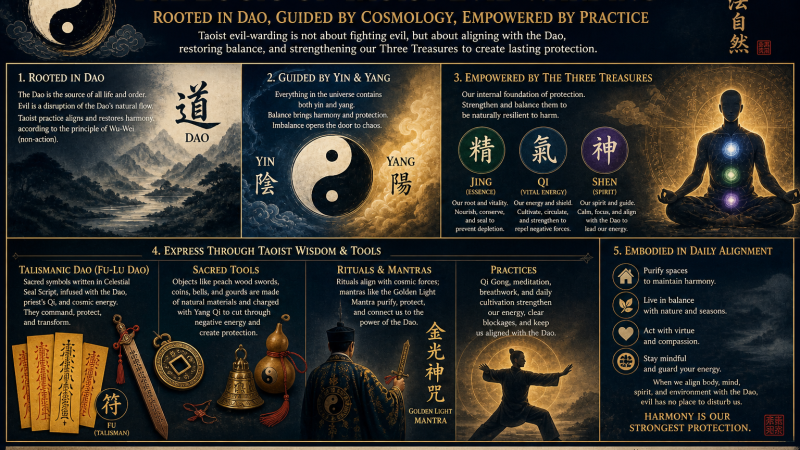
At the core of this logic is the Dao, the unnameable, eternal, and omnipresent “Way” that is the source of all life, all energy, and all order in the universe. The Dao is neither good nor evil, but the balance from which all dualities—yin and yang, light and dark, order and chaos—emerge, and this is where Taoist evil-warding begins: evil is not a separate, malevolent force to be destroyed, but a disruption of the Dao’s natural flow. It manifests as chaotic, unbalanced energy—energy that has strayed from the Dao’s harmonious path—and it can take many forms: malevolent spirits that have lost their alignment with the Dao, stagnant or negative Qi (vital energy) that no longer flows freely, or even personal actions that tip the scales of yin and yang. For Taoists, the goal of evil-warding is never aggression; it is not about defeating evil but redirecting it back to the Dao, restoring order and harmony in a way that honors the Taoist principle of wu-wei, or non-action—working with the Dao, not against it, to achieve balance. A Taoist priest does not “fight” a malevolent spirit; instead, they use rituals, talismans, and energy work to guide that spirit back to the Dao, or to create a barrier that prevents its chaotic energy from disrupting the harmony of a person or space, honoring the Dao’s inherent desire for balance.
This balance is expressed most clearly through the dual forces of yin and yang, complementary and opposing energies that are constantly in flux yet always striving for equilibrium. Yin is the receptive, dark, feminine energy, while yang is the active, light, masculine energy, and everything in the universe—human beings, spaces, even spirits—contains both. When yin and yang are balanced, energy flows freely, and we are naturally protected from evil; when they are imbalanced, we become vulnerable, for imbalance is the gateway to chaos. A home that is dark, damp, and stagnant holds too much yin energy, a breeding ground for negative spirits, just as a person who feels lethargic, anxious, or disconnected has depleted yang energy, their energy field too weak to repel chaotic forces. Conversely, a space or person with balanced yin and yang radiates a strong, resilient energy that repels evil simply because it is aligned with the Dao’s natural flow. Every Taoist evil-warding practice, no matter how small, is an act of restoring this balance: lighting candles (yang energy) in a dark room (yin energy) to harmonize the space, practicing Qi Gong to move stagnant yin energy and cultivate yang energy in the body, or using talismans inscribed with yin-yang symbols to anchor harmony—all of these acts close the gateway to evil by returning to the balance that the Dao intends.
While the Dao and yin-yang form the external framework of Taoist evil-warding, the internal foundation lies in the Three Treasures—Jing (Essence), Qi (Vital Energy), and Shen (Spirit)—the physical, energetic, and spiritual components of our connection to the Dao. Together, they form our internal protection system, and evil preys on their weakness; when they are strong and balanced, we are naturally resilient, but when they are weakened or imbalanced, we become susceptible to spiritual harm. Jing is our innate life essence, inherited from our ancestors and the foundation of our physical health, like the roots of a tree that keep it stable during a storm—strong Jing keeps us grounded in the face of chaotic energy, while depleted Jing (from stress, overwork, or spiritual attack) leaves us vulnerable. Taoists nurture their Jing through balanced, seasonal foods aligned with Taoist dietary principles, avoiding excessive indulgence that drains this precious essence, and practicing “Guarding Jing,” a mindfulness practice that preserves our vitality by focusing on the present moment and avoiding unnecessary energy expenditure.
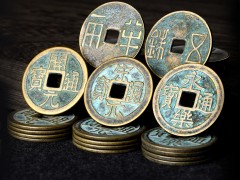
Qi, the vital energy that flows through our bodies along meridians and connects us to the universe, acts as our invisible shield. Taoism teaches that “Qi is the foundation of all things,” and when it flows freely and strongly, it creates a barrier that repels negative Qi and blocks malevolent spirits. This is where iconic Taoist tools come into play: peach wood swords, carved from sacred wood that naturally contains pure yang Qi and charged by a Taoist priest to cut through negative energy, and talismans inscribed with sacred Celestial Seal Script, infused with the priest’s Qi and the Qi of the Dao to act as a portable shield that amplifies our own energy field. Even practices like Qi Gong and breathwork are designed to unblock stagnant Qi, strengthening this invisible barrier so that evil energy cannot enter our bodies or spaces.
Shen, our spirit—the consciousness, soul, and part of us that connects directly to the Dao—acts as the guide for our Qi. A strong, calm Shen keeps our energy focused and cohesive, while a scattered Shen (from fear, anxiety, or spiritual disturbance) leaves our Qi unguided and our Jing vulnerable. Taoists strengthen their Shen through meditation focused on aligning with the Dao, chanting sacred mantras like the Golden Light Mantra that calm the spirit and amplify positive energy, and ritual purifications that clear the Shen of negative attachments. These practices keep us centered, even in the face of chaos, ensuring that our Qi flows in the right direction and our Jing remains protected.
Taoist evil-warding logic is not just theoretical; it is practical, a way of life that translates seamlessly into daily actions, even for North American practitioners new to the tradition. Aligning with the Dao can start with a simple five-minute daily practice in nature, focusing on the flow of energy around you—the wind, the trees, the sun—to tune into the Dao’s harmony and recognize when your energy or space is out of balance. Balancing yin and yang might mean adding warm lighting or plants to a dark, stagnant home, practicing gentle Qi Gong when you feel lethargic, or resting in a quiet, cool space when you feel overstimulated. Strengthening the Three Treasures is as simple as nurturing your body with rest and balanced food, practicing daily Qi Gong or breathwork, and calming your spirit with meditation or mantra chanting. When using Taoist tools like talismans or peach wood swords, it is important to remember they are not “magic charms” but amplifiers of your own energy and connection to the Dao—purchased from trained Taoist priests or reputable organizations to ensure they are charged with authentic Qi, as traditional talismans like those from the Lingbao Five Talismans require specific rituals to infuse them with protective energy. Even simple rituals, like burning sage (aligned with Taoist purification practices) and setting an intention to restore balance, can clear negative energy and protect your space by redirecting chaotic energy back to the Dao.
The most profound truth of Taoist evil-warding is that it is not a one-time practice but a way of life. Taoism teaches that we are constantly in relationship with the Dao, with yin and yang, and with our own Three Treasures—evil-warding is not something we do only when we feel threatened, but the daily act of aligning ourselves with the Dao, balancing our energy, and strengthening our inner power. For North American practitioners, this means letting go of the idea that evil-warding is about protecting ourselves from something scary; instead, it is about empowering ourselves to live in harmony with the natural order of the universe. When we are aligned with the Dao, when our yin and yang are balanced, and when our Three Treasures are strong, evil cannot exist in our presence—because chaos cannot thrive in a space of harmony. Taoist evil-warding is ultimately a practice of self-care and spiritual alignment, a recognition that we are part of something larger than ourselves, and that our greatest protection comes from living in harmony with the Dao. In the end, the logic is simple: align with the Dao, balance your energy, strengthen your self—and evil will have no hold.
Quick Answer
Explore the deeper logic of Taoist evil-warding, from Dao and yin-yang balance to Jing Qi Shen, Fulu talismans, peach wood swords, Qi Gong, and spiritual protection.
Questions This Guide Answers
- What does The Logic of Taoist Evil-Warding: Rooted in Dao mean in Taoist, Feng Shui, or modern spiritual culture?
- How can readers understand protection jewelry, amulets, talismans, charms, luck rituals, or symbolic objects without treating them as guaranteed outcomes?
- How does this idea connect to personal intention, cultural meaning, and everyday mindful practice?
Reader Note
Seer articles explain cultural symbolism and spiritual traditions for general learning. They are not medical, financial, or legal advice.
Recommended Protection Pieces
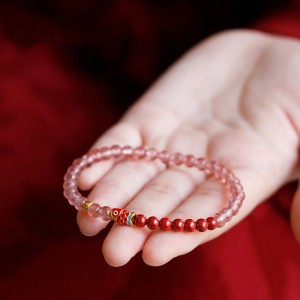
- Dawn Guardian Cinnabar Bracelet — A natural cinnabar bracelet embodying the Taoist principle of Yang energy protection discussed in this guide.
- The Night Ward Cinnabar & Peach Wood Bracelet — Combines two historically protective materials — cinnabar and peach wood — representing the Yin-Yang balance at the heart of Taoist evil-warding.
- Thunder Command Jujube Wood Charm — A hand-carved jujube wood Taoist amulet with Shangui coin, the physical manifestation of protective intention.
Related Protection Collections
- Protection Charms — Jewelry and accessories for spiritual protection, warding off evil, and personal safety.
- Taoist Talismans — Consecrated Taoist protective amulets and charms, including Five Thunder, Seven-Star Sword, and Bagua talismans.
- Peach Wood Protection Charms — Lightning-struck wood (Lei Ji Mu / 雷击木) charms and accessories for powerful Taoist protection.
- Cinnabar Bracelets — Traditional Zhu Sha (朱砂) bracelets for protection, positive energy, and spiritual grounding.
Continue Reading: Taoist Protection Deep Dives
- Taoist Protective Amulets and Talismans: A Complete Guide — Types, materials, traditions, and how to choose an authentic protective amulet.
- Spiritual Protection Mantra: Ward Off Evil — How Taoist mantras function as protective tools and how to use them effectively.
- Divinely Blessed Wood: Lei Ji Mu and Taoist Protection — Why lightning-struck wood is one of the most powerful protective materials in Taoist tradition.
- Why Cinnabar Works for Warding Off Evil — The history, meaning, and science behind cinnabar in Taoist protective jewelry.
Leave a comment