
Clearing the Confusion – Only Taoism Has True Evil-Warding Wisdom for North American Practitioners
If you’ve ever wandered through a Chinatown in North America, browsed spiritual shops online, or even joined a local Eastern spiritual circle, you’ve probably encountered “evil-warding” items labeled with vague “Eastern spiritual” tags—from peach wood swords to talismans, from incense burners to meditation chants. But here’s a critical truth that’s often lost in cross-cultural translation: evil-warding, as a systematic, ritualized practice rooted in ancient philosophy and cosmology, is uniquely a core part of Taoism (Daoism), not Buddhism.
For many North American spiritual seekers, Eastern religions like Taoism and Buddhism are often lumped together as “similar” or “interchangeable”—both originate from East Asia, emphasize harmony, and have rich ritual traditions. But when it comes to warding off negative energy, evil spirits, or misfortune, the two traditions have fundamentally different philosophies, practices, and goals. Today, we’re setting the record straight: if you’re looking for authentic evil-warding guidance, you need to turn to Taoism—not Buddhism—and here’s why.
First: The Core Difference – Evil-Warding Is in Taoism’s DNA
To understand why Taoism is the home of evil-warding, we first need to grasp the foundational beliefs of both traditions. Taoism, China’s indigenous spiritual tradition, is built around the concept of Dao (the Way)—the underlying force that governs all of nature, balance, and existence. Central to Taoist philosophy is the idea of yin and yang, the dualistic forces that must remain in harmony to maintain order. When this balance is disrupted—by negative energy, malevolent spirits, or human actions—misfortune, illness, or chaos follows. Evil-warding in Taoism is not just a “superstition”; it’s a practice designed to restore yin-yang balance and protect the individual or space from forces that disrupt the Dao.
This isn’t an afterthought for Taoism—it’s woven into its very fabric. From its earliest origins, Taoism absorbed ancient Chinese shamanic practices and folk beliefs about spirits, then systematized them into a coherent framework of rituals, tools, and teachings. Today, even as Taoism spreads across North America—from the Houston Taoist Association founded by Master Ma Jingrui to converted Taoist temples in Los Angeles Chinatown—the practice of evil-warding remains a core part of its mission to preserve traditional wisdom.
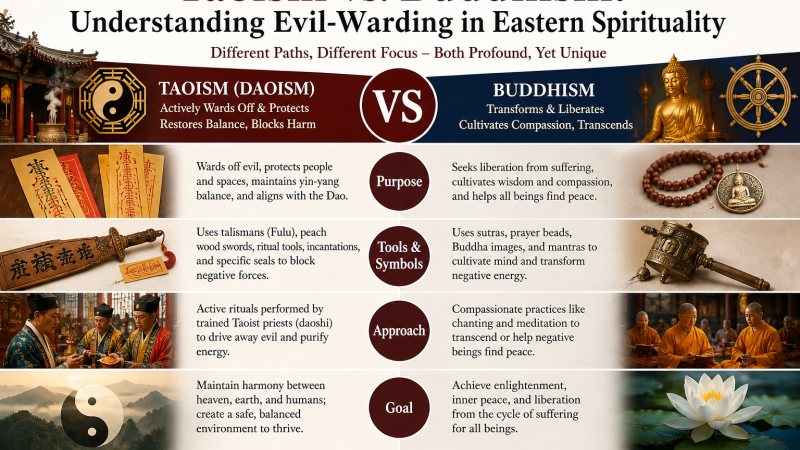
Buddhism, by contrast, has a completely different focus. Founded on the teachings of the Buddha, Buddhism’s core goal is to end suffering (dukkha) through enlightenment (nirvana), by overcoming attachment, ignorance, and craving. Buddhism does acknowledge the existence of negative energies or spirits, but it does not teach “evil-warding” in the Taoist sense. Instead, Buddhist practices related to negative forces focus on compassion, transcendence, and超度—helping spirits find peace, rather than driving them away or blocking them.
Let’s be clear: Buddhism is not “weaker” or “less spiritual” for this—it’s simply a different path. A Buddhist monk might chant sutras to calm negative energy, but this is an act of compassion, not protection. A Taoist priest, on the other hand, will use ritual tools, talismans, and specific chants to actively ward off evil, because Taoism recognizes that humans need to protect themselves from imbalances in the natural and spiritual world to live in harmony with the Dao.
Taoist Evil-Warding: A System Built on Cosmic Balance (Not Random Rituals)
One of the biggest mistakes North American practitioners make is assuming that any “Eastern” ritual or item counts as “evil-warding.” True Taoist evil-warding is a structured practice, rooted in Taoist cosmology, and it revolves around three key pillars—all of which have no direct equivalent in Buddhism:
1. The Role of Taoist Priests and Rituals
Taoist evil-warding is not a “do-it-yourself” practice; it requires training, lineage, and an understanding of Taoist cosmology. Taoist priests (daoshi) spend years studying classic texts like the Dao De Jing and Zhuangzi, mastering rituals, and learning to channel the energy of the Dao. For example, the practice of Five Thunder Method (Wulei Zhengfa), a core Taoist evil-warding ritual, involves invoking the power of five celestial thunder gods to drive away malevolent spirits and purify negative energy—a practice that has been refined for centuries and is unique to Taoist tradition.
In North America, Taoist leaders like Master Ma Jingrui have adapted these rituals to local contexts, using accessible language to explain their purpose while preserving their authenticity. Through organizations like the Houston Taoist Association, they teach practitioners that evil-warding is not about fear, but about aligning with the natural order of the Dao.
2. Sacred Tools: Designed for Protection (Not Devotion)
Taoist evil-warding tools are iconic, but they’re not just decorative—each has a specific purpose tied to Taoist cosmology:
-
Peach Wood Swords:桃木剑 (Táomù Jiàn) – Peach wood has been revered in Chinese culture as a sacred material that repels evil since ancient times, with references dating back to Qin Dynasty texts like the Daybook (Rishu). Taoism formalized this belief, using peach wood swords as a core法器 (fǎqì, ritual tool) to channel Taoist energy and cut through negative forces. Unlike Buddhist prayer beads (used for meditation) or stupas (used for devotion), the peach wood sword’s sole purpose is protection.
-
Talismans (Fulu): Taoist talismans are not “lucky charms”—they are sacred symbols inscribed with Taoist characters, symbols, and invocations that channel the energy of the Dao, gods, or ancestors. A properly inscribed talisman, created by a trained Taoist priest, is used to ward off evil, protect a home, or bring harmony. Buddhism has no equivalent to Taoist talismans; Buddhist symbols like the Dharma wheel or lotus flower represent teachings, not protective energy.
-
Fu Yin (Taoist Seals): These sacred seals are used by priests to authenticate talismans and rituals, acting as a bridge between the human and spiritual realms. They are a key part of Taoist evil-warding, as they signify the priest’s authority to invoke the Dao’s protection—a practice entirely distinct from Buddhist rituals.
Even as Taoism adapts to North America—with practitioners like Alex Anatol patenting Taoist healing techniques to protect their authenticity—these core tools remain central to evil-warding practice, connecting modern seekers to ancient wisdom.
3. The Goal: Protection to Maintain Harmony
Taoist evil-warding is not about “fighting evil” or “conquering darkness”—it’s about protection and balance. The Dao teaches that all things are interconnected; when negative energy invades a space or person, it disrupts the natural flow of yin and yang. Taoist evil-warding rituals (like house purifications or personal protections) clear this negative energy, allowing the Dao to flow freely again. This aligns with Taoism’s core goal: to live in harmony with nature, the self, and the spiritual world.
Buddhism, by contrast, teaches that suffering (including negative energy) arises from within. The solution is not to “ward off” external forces, but to cultivate inner peace and wisdom. A Buddhist might practice mindfulness to detach from negative emotions, but this is an internal practice—not an external protection. There is no Buddhist equivalent to a Taoist house purification, because Buddhism does not frame “evil” as an external force to be blocked.
Why This Matters for North American Spiritual Seekers
In a market saturated with “Eastern spiritual” products—from “Buddhist talismans” to “zen evil-warding incense”—it’s easy to get confused. But understanding the difference between Taoism and Buddhism isn’t just about intellectual accuracy; it’s about getting the results you’re seeking.
If you’re looking to protect your home, clear negative energy, or shield yourself from malevolent forces, turning to Buddhism will leave you disappointed—because that’s not what Buddhism is for. Taoism, however, has spent millennia refining its evil-warding practices, adapting them to different cultures, and preserving their effectiveness. Today, Taoist communities across North America—from New York’s Tianhou Temple to Arizona’s Zhongfu Taoist Temple—offer authentic evil-warding guidance, rooted in tradition but accessible to modern seekers.
This confusion often stems from cultural misappropriation and oversimplification. Early Chinese immigrants to North America brought both Taoist and Buddhist practices with them, mixing them in temples to maintain spiritual connection in a new land. Over time, Western culture blurred the lines, treating all Eastern traditions as a single “spiritual buffet”. But as Taoist leaders like Master Ma Jingrui work to build organized Taoist communities in North America, they’re helping to restore clarity—teaching that Taoism’s evil-warding wisdom is a unique, sacred practice, not a generic “Eastern” trend.
Final Thought: Embrace Authenticity in Your Spiritual Journey
Spirituality is a personal journey, and there’s no “right” path—but there is authenticity. Buddhism offers profound wisdom for inner peace and enlightenment, and Taoism offers powerful tools for protection and harmony with the natural world. Both are beautiful, but they are not the same.
For North American practitioners interested in evil-warding, take the time to learn from authentic Taoist sources: connect with local Taoist associations, study under trained priests, or explore the teachings of Taoist leaders who have dedicated their lives to preserving this wisdom. Remember: true evil-warding isn’t about trendy items or vague chants—it’s about aligning with the Dao, restoring balance, and protecting yourself in a way that honors the ancient tradition that created this practice.
The next time you see an “evil-warding” item labeled “Buddhist,” pause and remember: that’s a misunderstanding. Evil-warding is Taoist through and through—and once you embrace that truth, you’ll find a deeper, more effective connection to Eastern spiritual wisdom.
Quick Answer
Understand the difference between Taoist protection and Buddhist practice, including Taoist talismans, peach wood swords, Fulu, ritual tools, and evil-warding traditions in Chinese spirituality.
Questions This Guide Answers
- What does Clearing the Confusion mean in Taoist, Feng Shui, or modern spiritual culture?
- How can readers understand protection jewelry, amulets, talismans, charms, luck rituals, or symbolic objects without treating them as guaranteed outcomes?
- How does this idea connect to personal intention, cultural meaning, and everyday mindful practice?
Reader Note
Seer articles explain cultural symbolism and spiritual traditions for general learning. They are not medical, financial, or legal advice.
Leave a comment