
As spiritual wellness becomes more visible in North America, protection charms are often discussed through familiar ideas such as good luck, intention, and emotional grounding. But Taoist-inspired protection symbols, Fu talismans, and herbal sachets come from a deeper cultural system connected with harmony, ritual order, seasonal protection, and symbolic blessing.
In North America, the phrase “protection charm” is easy to understand. It suggests an object carried for safety, reassurance, blessing, or good fortune. From religious medals to crystals, from lucky bracelets to symbolic pendants, people have long used small objects to express hopes that are larger than words.
But Taoist-inspired protection symbols belong to a more specific cultural world. They are not simply accessories, and they are not the same as Western lucky charms. They come from a tradition shaped by ideas of harmony, qi, ritual order, nature, seasonal change, and the relationship between visible life and unseen forces.
As spiritual wellness becomes more visible in modern culture, Taoist protection objects offer a different way to understand protection: not as a dramatic promise, but as a symbolic practice of balance, intention, and cultural memory.
A Different Understanding of Protection
In many modern conversations, protection is understood in a simple way: keeping something bad away. But in Taoist and Chinese folk traditions, protection often has a wider meaning.
It can mean restoring balance.
It can mean creating order in a chaotic moment.
It can mean carrying a blessing.
It can mean honoring seasonal transitions.
It can mean placing a meaningful object between the self and uncertainty.
National Geographic describes Taoism as a tradition that teaches living in harmony with the universe and the energy within it, often called qi. This idea is important because it shows that Taoist-inspired protection is not only about fear or defense. It is also about alignment, calm, and balance.
This is why Taoist protection symbols can feel especially relevant today. Many people are not only looking for “luck.” They are looking for emotional structure, daily grounding, and objects that help them feel connected to something meaningful.
From Lucky Object to Cultural Symbol
North American consumers are already familiar with spiritual objects. Crystals, tarot cards, astrology, incense, candles, and intention bracelets are now common in lifestyle, wellness, and gift culture. But many of these objects are understood through personal energy, self-reflection, or manifestation.
Taoist-inspired objects bring another layer: cultural symbolism.
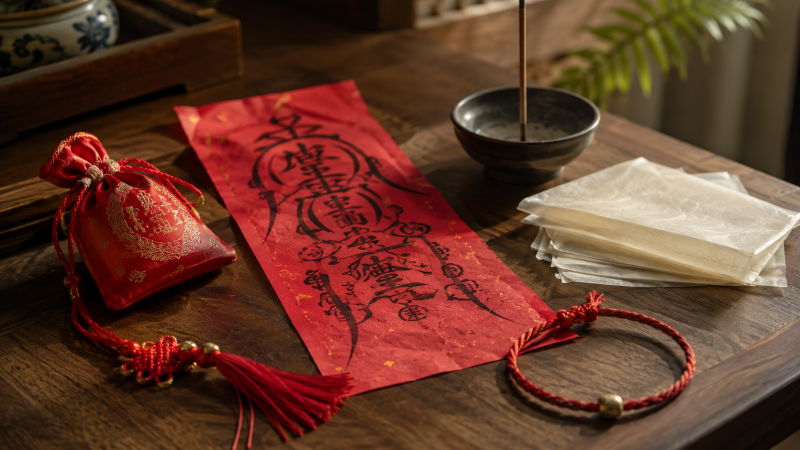
A Taoist Fu talisman, a red protection cord, a herbal sachet, or a small amulet pouch may look simple, but each belongs to a larger visual and ritual language. These objects often combine color, material, writing, scent, placement, and timing.
Red may suggest blessing and protection.
A written symbol may suggest order and intention.
Herbs may suggest cleansing and seasonal care.
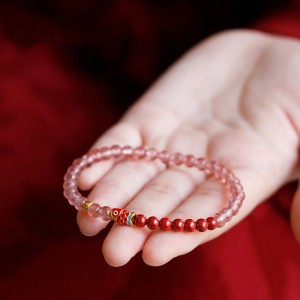
A cord or pouch may suggest carrying protection close to the body.
The object is small, but the meaning is layered.
What Is a Fu Talisman?
A Fu talisman is one of the most recognizable forms of Taoist protection symbolism. In simple terms, it is a talismanic symbol traditionally associated with Taoist ritual writing.
To a North American reader, a Fu talisman may first appear as mysterious calligraphy. But it is not meant to function like ordinary writing. It belongs to a symbolic system where lines, marks, characters, seals, and ritual forms can carry spiritual or cultural meaning.
The Stanford Encyclopedia of Philosophy discusses protective talismans, known as fu, in the context of religious Daoist practice, showing that talismanic protection has been part of Daoist religious history rather than a modern decorative invention.
For an independent-site audience, the safest and most respectful way to explain Fu talismans is not to claim that they guarantee a result. Instead, they can be described as:
- Taoist-inspired protection symbols
- traditional visual expressions of blessing
- cultural objects associated with peace and protection
- symbolic reminders of order, boundary, and intention
- spiritual objects rooted in Chinese religious and folk traditions
This language keeps the meaning strong while avoiding exaggerated claims.
Taoism Is Not Just “Mysticism”
One challenge for North American audiences is that Taoism is often misunderstood. Some people only associate it with yin-yang symbols, meditation, or vague ideas of “energy.” Others may know almost nothing about it.
But Taoism is not simply a mood or aesthetic. The Metropolitan Museum of Art explains that Daoism developed into an organized religion with a growing canon of texts, a pantheon of gods, and multiple schools with different ideas and approaches.
That matters for your article because it helps position Taoist-inspired products as culturally grounded, not random “mystic” objects.
A Taoist protection symbol is not just a cool-looking graphic. It carries a relationship to a larger tradition of ritual, writing, cosmology, blessing, and symbolic order.
This is also why the wording on a modern product page should be careful. The goal is not to make extreme supernatural promises. The goal is to explain the object’s traditional association and emotional meaning.
Why Herbal Sachets Matter
Fu talismans are one side of Taoist-inspired protection culture. Herbal sachets are another.
A herbal sachet is more physical and sensory. It uses fabric, scent, herbs, thread, and touch. Unlike a printed symbol, it can be carried, hung, smelled, gifted, or placed in a personal space.
In Chinese seasonal traditions, sachets are especially connected with the Dragon Boat Festival. Smithsonian Folklife Magazine explains that because the festival occurs during the hot and humid summer, people believed aromatic plants could ward off bugs, diseases, and evil forces.
For a modern North American audience, this can be translated carefully.
A sachet should not be marketed as a medical object. It should not promise to cure, prevent illness, or remove danger. But it can be presented as a cultural object traditionally associated with seasonal protection, cleansing, blessing, and peace.
That makes the sachet especially useful for modern lifestyle storytelling.
It can hang in a car as a safe-travel blessing.
It can be placed near a bedside as a calming object.
It can be attached to a bag as a personal charm.
It can be given as a meaningful gift during a new season, move, trip, or life transition.
The product becomes more than fragrance. It becomes a small, symbolic ritual.
The Role of Scent, Color, and Placement
One reason herbal sachets work well for modern audiences is that they are easy to understand through the senses.
A Fu talisman may require cultural explanation.
A sachet is immediately physical.
You can see the color.
You can feel the fabric.
You can notice the scent.
You can choose where to place it.
This makes sachets a bridge between traditional protection culture and modern lifestyle use.
In a North American context, this is important. Many customers may not know Taoist history. But they understand the idea of a meaningful object in a car, bedroom, entryway, or personal bag. They understand scent as atmosphere. They understand gifts as emotional gestures. They understand protection as a feeling of care.
The article should use that bridge: start from what they understand, then guide them into the deeper Taoist and Chinese cultural meaning.
Why Taoist Protection Symbols Are Different From Ordinary Good Luck Charms
A good luck charm is often about outcome: more luck, better fortune, a favorable result.
A Taoist-inspired protection object is better understood through relationship: the relationship between person and place, body and environment, season and ritual, visible object and invisible meaning.
That distinction makes the article more professional.
Instead of saying:
“This charm brings luck.”
Say:
“This charm is traditionally associated with blessing, protection, and balance.”
Instead of saying:
“This sachet removes negative energy.”
Say:
“This sachet draws from seasonal protection traditions and can be used as a symbolic reminder of peace and care.”
Instead of saying:
“This talisman protects you.”
Say:
“This Taoist-inspired talisman carries cultural associations of protection, order, and spiritual intention.”
This style is more credible, safer for a North American market, and better for long-term brand trust.
Why This Matters in Modern Spiritual Culture
The modern spiritual market is full of products that look beautiful but have little explanation. Many customers see words like “energy,” “protection,” “manifestation,” or “cleansing,” but they do not always know the cultural background behind them.
That creates an opportunity for a more professional Taoist-inspired brand.
A strong independent site should not only sell objects. It should explain them.
It should answer:
Where does this symbol come from?
What does it traditionally represent?
How can a modern person use it respectfully?
What should we avoid claiming?
How does this object connect with peace, balance, and intention?
This kind of content helps the customer trust the brand. It also helps search engines understand that the website is not producing thin mystical content, but offering cultural explanation, source-based context, and careful interpretation.
A Responsible Way to Talk About Protection
The most important point is this: modern protection products should avoid absolute promises.
Do not claim that a talisman guarantees safety.
Do not claim that a sachet cures illness.
Do not claim that a charm removes all bad luck.
Do not claim that a product changes someone’s destiny.
Instead, use language that is traditional, symbolic, and emotionally clear:
“traditionally associated with protection”
“a symbolic reminder of peace and balance”
“inspired by Taoist protection culture”
“a meaningful object for intention and grounding”
“a blessing gift for daily life and personal spaces”
This wording does not weaken the product. It actually makes it more professional.
North American customers are often skeptical of extreme claims, but they can appreciate cultural depth, emotional meaning, and beautiful objects with a story.
The Modern Value of Taoist-Inspired Objects
Taoist-inspired Fu talismans and herbal sachets are not just decorative items. They are cultural objects that can help modern people build small rituals around protection, peace, and grounding.
A red talisman can become a visual reminder of order.
A herbal sachet can become a sensory reminder of calm.
A protection cord can become a daily reminder of intention.
A charm placed in a car or bedroom can become a quiet sign of care.
In this sense, the modern value of these objects is not only in what they promise, but in what they help people remember.
To slow down.
To seek balance.
To carry peace.
To honor tradition.
To place meaning back into ordinary spaces.
That is why Taoist protection symbols deserve to be understood beyond the simple category of “good luck charms.” They belong to a larger conversation about culture, spiritual wellness, symbolic protection, and the modern search for grounding.
FAQ
What is a Taoist protection symbol?
A Taoist protection symbol is a cultural or spiritual object inspired by Taoist ideas of harmony, blessing, order, and symbolic protection. It may appear as a Fu talisman, red cord, sachet, amulet pouch, or other meaningful object.
What is a Fu talisman?
A Fu talisman is a traditional Taoist talismanic form often connected with ritual writing, symbolic marks, and protection meanings. In a modern context, it is best understood as a cultural symbol associated with blessing, peace, and intention.
Are herbal sachets part of Chinese protection culture?
Yes. Herbal sachets are strongly connected with Chinese seasonal customs, especially the Dragon Boat Festival. They are traditionally associated with fragrance, cleansing, protection, and seasonal blessing.
Do Taoist protection charms guarantee safety or luck?
No. They should not be described as guaranteed protection or a promise of specific results. A responsible modern interpretation presents them as symbolic objects connected with tradition, intention, and emotional grounding.
How can these objects be used today?
They can be placed in a car, bedroom, entryway, bag, closet, or personal space. They can also be given as meaningful gifts for travel, moving, new beginnings, or moments when someone may appreciate a symbol of peace and care.
Quick Answer
A professional cultural analysis of Taoist protection symbols, Fu talismans, herbal sachets, and how they can be understood in modern spiritual wellness culture.
Questions This Guide Answers
- What does Beyond Good Luck Charms: How Taoist Protection Symbols Can Be Understood in Modern Spiritual Culture mean in Taoist, Feng Shui, or modern spiritual culture?
- How can readers understand protection jewelry, amulets, talismans, charms, luck rituals, or symbolic objects without treating them as guaranteed outcomes?
- How does this idea connect to personal intention, cultural meaning, and everyday mindful practice?
Reader Note
Seer articles explain cultural symbolism and spiritual traditions for general learning. They are not medical, financial, or legal advice.
Leave a comment