
The Wisdom of Taoist Medicine
Taoist medicine is not merely a system of treating illness—it is a sacred philosophy of life, rooted in the ancient wisdom of the Dao, that views the human body as a microcosm of the universe, where health is not just the absence of disease, but a state of perfect harmony between the body, mind, spirit, and the natural world. Unlike modern medicine that often treats symptoms in isolation, Taoist medicine seeks to uncover the root cause of imbalance, believing that every physical ailment is a reflection of disharmony in energy, spirit, or alignment with the Dao. It is a holistic practice that merges healing with spiritual cultivation, reminding us that to heal the body, we must first align with the rhythms of nature and nurture the connection between our physical and spiritual selves.
At the core of Taoist medicine lies the principle of “Yiyidaotong”—the unity of medicine and the Dao. This ancient tenet teaches that medicine and the Dao share the same origin: both are rooted in the observation of nature’s cycles, the balance of Yin and Yang, and the flow of Qi (vital energy) that animates all living things. Taoist medicine does not separate the body from the spirit; it recognizes that we are spiritual beings in physical form, and that true health requires the harmony of both Xing (body) and Shen (spirit)—a concept known as “Xingshenjianzhi” (treating both body and spirit). This is why Taoist healers, from ancient masters like Ge Hong and Sun Simiao to modern practitioners, do not just prescribe herbs or acupuncture; they guide their patients to live in accordance with the Dao, to nurture their Qi, and to cultivate a peaceful mind—for without spiritual harmony, physical health is fleeting.
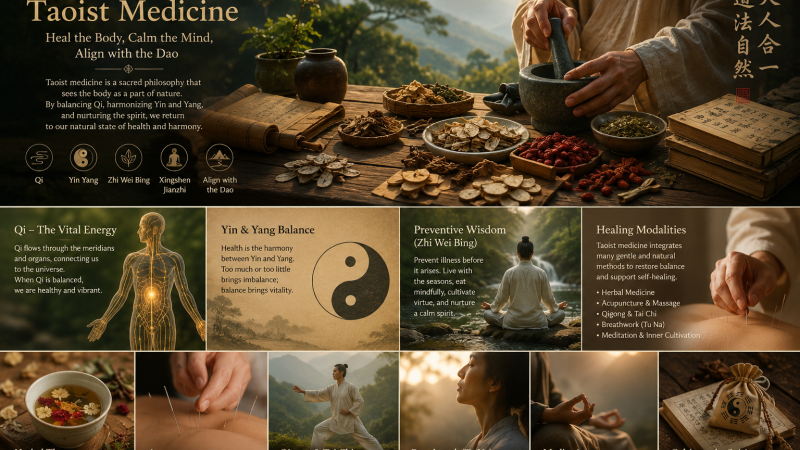
The foundation of Taoist medicine is the understanding of Qi, the invisible vital energy that flows through every part of the body, connecting organs, meridians, and the spirit to the universe. Qi is the life force that sustains us; when it flows freely and abundantly, we are healthy, vibrant, and aligned with the Dao. When it is stagnant, blocked, or depleted, illness arises—whether it is a minor cold, a chronic ache, or a deep spiritual malaise. Taoist medicine teaches that Qi imbalance can stem from many sources: ignoring the rhythms of nature (staying up late, eating out of season), harboring negative emotions (anger, greed, anxiety) that disrupt the flow of energy, or living a life out of alignment with our true nature. In this way, illness is not a punishment, but a gentle reminder—a signal that we have strayed from the Dao’s path and need to return to balance.
Yin and Yang, the complementary forces that govern all aspects of existence, are another cornerstone of Taoist medicine. Yin represents the cool, receptive, nourishing energy (associated with the moon, night, and the inner organs like the kidneys and liver), while Yang represents the warm, active, protective energy (associated with the sun, day, and the heart and lungs). Health is a state of dynamic balance between these two forces; when one is too strong or the other too weak, imbalance occurs. For example, an excess of Yin energy might manifest as fatigue, cold limbs, or digestive issues, while an excess of Yang could lead to inflammation, restlessness, or insomnia. Taoist medicine seeks to restore this balance through gentle, natural methods—adjusting diet, practicing breathwork, or using herbs that harmonize Yin and Yang—rather than suppressing symptoms with force.
Unlike modern medicine’s focus on “treating disease,” Taoist medicine emphasizes“Zhiweibing”—preventing illness before it arises. This proactive approach is rooted in the belief that the body has an innate ability to heal itself, as long as it is nurtured and aligned with the Dao. Taoist practitioners guide their patients to live in harmony with the seasons: eating seasonal foods that support the body’s changing needs (sour foods to nourish the liver in spring, bitter foods to calm the heart in summer), practicing gentle movements like Qigong or Tai Chi to keep Qi flowing, and cultivating mindfulness to calm the mind and prevent emotional stagnation. They also teach the importance of “Baoshen” (guarding the spirit)—avoiding excessive indulgence, letting go of attachment, and nurturing kindness and compassion, as negative emotions are seen as one of the greatest drains on Qi and spiritual health.
Taoist medicine also embraces the concept of “Chengfu” (karmic inheritance), which suggests that our health is not just a product of our own actions, but also of the choices of our ancestors and the energy we carry from past experiences. This is not a fatalistic belief, but a reminder that we are part of a larger web of life, and that healing requires us to honor this connection—by cultivating virtue, letting go of past harm, and nurturing positive energy that benefits both ourselves and future generations. In this way, Taoist medicine is not just about healing the individual, but about healing the whole—restoring harmony between humans, nature, and the Dao.
The practices of Taoist medicine are as diverse as they are profound, reflecting its principle of “Zhongshuhexiu” (integrating multiple methods). They include herbal remedies made from natural plants and minerals, chosen for their ability to harmonize Qi and balance Yin and Yang; acupuncture and massage to unblock meridians and restore energy flow; breathwork (Tu Na) to draw in pure cosmic Qi and expel stagnant energy; and meditation to calm the Shen and connect with the Dao. Even simple daily practices—like sipping warm herbal tea, practicing mindful breathing, or spending time in nature—are considered part of Taoist healing, as they nurture the body, calm the mind, and align us with the natural world.
What makes Taoist medicine truly unique is its belief that healing is a spiritual journey. It teaches us that illness is not an enemy to be fought, but an opportunity to grow—to reconnect with our true nature, to let go of what no longer serves us, and to align our lives with the Dao. A Taoist healer does not just “cure” a patient; they guide them to heal themselves, by teaching them to listen to their body, to nurture their Qi, and to live in harmony with the rhythms of nature. In this way, Taoist medicine is not just a system of healing—it is a way of life, a path to wholeness that unites the body, mind, and spirit in perfect harmony with the Dao.
In a world that often prioritizes quick fixes and external solutions, Taoist medicine offers a gentle, profound alternative: true health comes from within, from aligning ourselves with the Dao, nurturing our Qi, and cultivating a peaceful, compassionate mind. It reminds us that we are not separate from nature, but part of it—that our bodies are vessels of the Dao’s energy, and that healing is simply a return to the balance that is our natural birthright. This is the wisdom of Taoist medicine: to heal the body, we must first heal the spirit; to find health, we must first find alignment with the Dao.
Quick Answer
Explore Taoist medicine as a holistic healing philosophy rooted in Qi, Yin Yang balance, body-mind-spirit harmony, preventive wellness, Qigong, breathwork and alignment with the Dao.
Questions This Guide Answers
- What does Heal the Body, Calm the Mind, Align with the Dao mean in Taoist, Feng Shui, or modern spiritual culture?
- How can readers understand protection jewelry, amulets, talismans, charms, luck rituals, or symbolic objects without treating them as guaranteed outcomes?
- How does this idea connect to personal intention, cultural meaning, and everyday mindful practice?
Reader Note
Seer articles explain cultural symbolism and spiritual traditions for general learning. They are not medical, financial, or legal advice.
Leave a comment