

Beyond Talismans: Taoism’s Jing-Qi-Shen & Talismanic Wisdom
If you’ve read our last blog, you already know the critical truth: evil-warding is a core practice of Taoism, not Buddhism. But many North American spiritual seekers still have a question: What makes Taoist evil-warding so unique? Is it just about peach wood swords and talismans, or is there a deeper philosophy behind it?
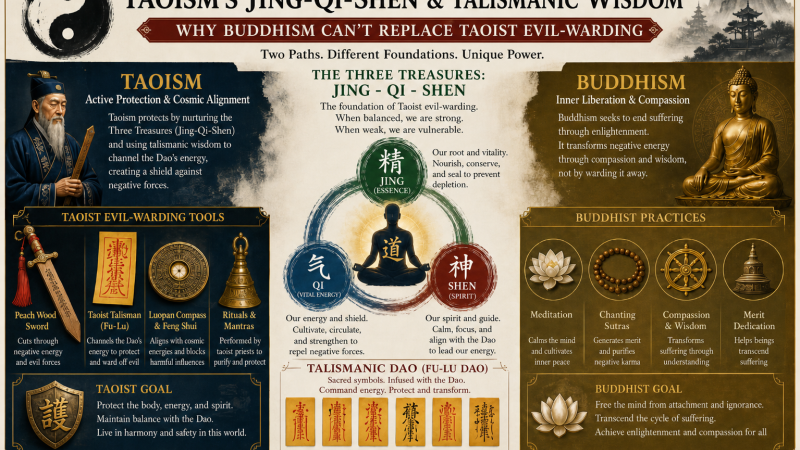
Today, we’re diving into a foundational Taoist theory that explains why its evil-warding practices are effective—and entirely distinct from Buddhism: the Jing-Qi-Shen (Essence-Qi-Spirit) system, paired with the sacred Talismanic Dao (Fu-Lu Dao). Unlike Buddhism’s focus on inner enlightenment to transcend suffering, Taoism’s evil-warding is rooted in nurturing and protecting the three treasures of human life (Jing, Qi, Shen) and using Taoist cosmology to channel the Dao’s energy—creating a shield against negative forces that Buddhism simply doesn’t address.
Let’s break this down, in plain language, for North American practitioners. By the end, you’ll understand why Taoist evil-warding isn’t “superstition”—it’s a holistic practice that connects your body, spirit, and the universe, and why Buddhism can never replicate it.
First: The Three Treasures (Jing-Qi-Shen) – The Foundation of Taoist Evil-Warding
Taoism teaches that every human being is born with three sacred treasures: Jing (Essence), Qi (Vital Energy), and Shen (Spirit). These three treasures are the source of our life force, our vitality, and our connection to the Dao—the underlying force of the universe. Together, they form a protective “energy field” around us; when they are balanced and strong, negative energy, evil spirits, and misfortune cannot penetrate. When they are weakened or imbalanced, we become vulnerable to spiritual harm.
This is where Taoist evil-warding begins: protecting and nurturing Jing-Qi-Shen. Unlike Buddhism, which views suffering as a product of inner ignorance and attachment, Taoism recognizes that external negative forces (evil spirits, chaotic energy) can directly damage our three treasures—disrupting our health, our peace, and our connection to the Dao. Evil-warding in Taoism is not just about “driving away evil”; it’s about strengthening our inner life force so that we are naturally resilient to harm.
Let’s define each treasure, and how they tie to evil-warding—something you’ll never learn in Buddhist teachings:
1. Jing (Essence): The “Root” of Our Protection
Jing is our innate life essence—the energy we inherit from our ancestors, the foundation of our physical health, and the “storehouse” of our vitality. Taoism teaches that Jing is like the roots of a tree: strong roots keep the tree stable and resistant to storms; strong Jing keeps us resistant to negative energy. When Jing is depleted (from stress, overwork, or spiritual attack), our protective energy weakens, and evil can take hold.
Taoist evil-warding practices for Jing include nourishing the body with healthy habits (aligned with Taoist dietary principles), avoiding excessive indulgence (which drains Jing), and using specific rituals to “seal” Jing within the body. For example, the Taoist practice of “Guarding Jing” (Shou Jing) involves mindfulness and breathwork to prevent the loss of essence—a practice that has no equivalent in Buddhism, which does not focus on physical essence as a protective barrier.
2. Qi (Vital Energy): The “Shield” Around Us
Qi is the vital energy that flows through our bodies (along meridians) and connects us to the universe. Taoism teaches that “Qi is the foundation of all things”—everything in the world, from plants to planets, is made of Qi. When our Qi flows freely and strongly, it creates an invisible shield around us, repelling negative Qi (evil energy) and blocking malevolent spirits.
This is where Taoist evil-warding tools like peach wood swords and talismans come into play: they are not just decorative—they are designed to channel and amplify Qi. A peach wood sword, for example, is carved from sacred peach wood (which naturally contains pure Qi) and charged by a Taoist priest to cut through negative Qi. A Taoist talisman, inscribed with sacred characters and symbols, is infused with the priest’s Qi and the Qi of the Dao—creating a portable shield that protects the wearer’s Qi field.
Buddhism, by contrast, does not focus on Qi as a protective force. Buddhist practices like meditation aim to calm the mind, not to strengthen or channel Qi. A Buddhist monk might chant to cultivate compassion, but this does not create a Qi shield—because Buddhism does not recognize Qi as a tool for warding off external evil.
3. Shen (Spirit): The “Guide” of Our Energy
Shen is our spirit—the consciousness, the soul, the part of us that connects to the Dao. Taoism teaches that a strong, calm Shen is essential for evil-warding: when our Shen is scattered or weakened (from fear, anxiety, or spiritual disturbance), we cannot focus our Qi, and our Jing becomes vulnerable. A strong Shen acts as a “guide” for our Qi, ensuring it flows in the right direction and creates a strong protective barrier.
Taoist evil-warding practices for Shen include meditation (focused on aligning with the Dao), chanting sacred mantras (like the Golden Light Mantra, which calms the Shen and amplifies positive energy), and ritual purifications (to clear the Shen of negative attachments). These practices are designed to strengthen the Shen, so it can lead our Qi and protect our Jing—creating a holistic defense against evil.
Buddhism’s approach to the spirit is very different: it focuses on transcending the cycle of rebirth by freeing the spirit from attachment, not on protecting it from external evil. A Buddhist might practice mindfulness to calm the mind, but this is about inner peace, not spiritual protection.
Talismanic Dao (Fu-Lu Dao): The “Bridge” Between Jing-Qi-Shen and the Dao
Now that we understand the three treasures, we can see why Taoist talismans are not just “lucky charms”—they are a sacred part of the Jing-Qi-Shen system. Taoism’s Talismanic Dao is a systematic practice that connects the practitioner’s Jing-Qi-Shen to the Dao, the gods, and the natural world—creating a powerful protective force that Buddhism cannot replicate.
Here’s the key difference: Taoist talismans are infused with the three treasures and the energy of the Dao. A properly inscribed talisman (created by a trained Taoist priest) is not just a piece of paper—it is a vessel for the priest’s Shen, charged with their Qi, and aligned with the Jing of the Dao. When you carry or display a Taoist talisman, it acts as an extension of your own Jing-Qi-Shen, amplifying your protective energy and connecting you to the Dao’s infinite power.
Buddhism has no equivalent to Taoist talismans. Buddhist symbols (like the Dharma wheel or lotus flower) represent teachings or enlightenment—they are not infused with Qi, nor are they designed to protect the three treasures. When you see a “Buddhist talisman” in a North American spiritual shop, it’s a misunderstanding: talismans are inherently Taoist, rooted in the Jing-Qi-Shen system and the Talismanic Dao.
Taoist talismans also have a rich history tied to the evolution of the tradition. From the early systematic talismans mentioned in the Eastern Han Dynasty’s Lingbao Five Talismans to the integration of talismans with inner alchemy in the Southern Song Dynasty—forming the principle of “cultivating the elixir internally, using the method externally”—talismans have always been a core part of Taoist evil-warding, evolving alongside the understanding of Jing-Qi-Shen.
Why Buddhism Can Never Replace Taoist Evil-Warding
The core difference boils down to one simple truth: Taoism focuses on protecting the physical and spiritual self from external evil, while Buddhism focuses on transcending internal suffering. Both are valid spiritual paths, but they serve different purposes.
Buddhism teaches that all suffering (including negative energy) comes from within—from attachment, ignorance, and craving. The solution is to cultivate inner wisdom and compassion to transcend this suffering. There is no need for “evil-warding” in Buddhism because the “evil” we face is not an external force—it is a product of our own minds. A Buddhist might chant sutras to calm negative emotions, but this is an internal practice, not a protective one.
Taoism, however, recognizes that external evil exists—negative Qi, malevolent spirits, and chaotic energy that can damage our Jing-Qi-Shen and disrupt our harmony with the Dao. Evil-warding in Taoism is a practical, holistic practice that uses the three treasures and the Talismanic Dao to protect ourselves, our homes, and our loved ones. It is not about fear—it is about strength, balance, and alignment with the natural order of the universe.
For North American practitioners, this is a crucial distinction. If you’re looking to protect your energy, clear your space, or shield yourself from spiritual harm, Buddhism cannot help you—because that’s not what it’s designed to do. Taoism, with its focus on Jing-Qi-Shen and Talismanic Dao, offers a proven, ancient system of protection that has been refined for millennia.
How to Practice Taoist Evil-Warding Authentically (For North Americans)
You don’t need to be a Taoist priest to incorporate these practices into your life. Here are simple, authentic ways to protect your Jing-Qi-Shen and ward off evil—rooted in Taoist tradition:
-
Nurture Your Jing: Prioritize rest, eat nourishing foods (aligned with Taoist principles of balance), and avoid excessive stress or indulgence. This strengthens your life essence and creates a foundation for protection.
-
Strengthen Your Qi: Practice gentle Qi Gong (a Taoist practice that cultivates and moves Qi) for 10–15 minutes daily. This helps your Qi flow freely, creating a natural shield around you. You can find beginner Qi Gong classes at local Taoist associations or online through authentic Taoist teachers.
-
Calm Your Shen: Chant the Golden Light Mantra (a sacred Taoist mantra) daily. This mantra calms the spirit, amplifies positive energy, and strengthens your Shen—making you less vulnerable to negative forces. The mantra, rooted in the Orthodox Taoist Canon, invokes a protective golden light that surrounds the body, repelling evil and calming the mind.
-
Use Authentic Taoist Talismans: If you want to use a talisman, purchase one from a trained Taoist priest or a reputable Taoist organization (like the Houston Taoist Association or New York’s Tianhou Temple). Avoid “Buddhist talismans”—they are not authentic and will not protect your Jing-Qi-Shen.
Final Thought: Embrace the Wisdom of the Three Treasures
Taoist evil-warding is not about fear—it’s about empowerment. By nurturing your Jing-Qi-Shen and aligning with the Dao, you create a strong, resilient energy field that repels evil and brings harmony to your life. Buddhism offers profound wisdom for inner peace, but when it comes to protection, Taoism is the only tradition with a systematic, effective approach.
For North American spiritual seekers, the key is to embrace authenticity. Don’t be fooled by “Eastern spiritual” products that mix Taoist and Buddhist practices—know that evil-warding is rooted in Taoist theory, in the three treasures, and in the Talismanic Dao. When you practice Taoist evil-warding authentically, you’re not just protecting yourself—you’re connecting to an ancient wisdom that has helped people thrive for thousands of years.
The next time you feel vulnerable to negative energy, remember: your Jing-Qi-Shen is your greatest protection. And Taoism is the only tradition that teaches you how to nurture and defend it.
Quick Answer
Learn how Taoist Jing Qi Shen, the Three Treasures of essence, energy and spirit, connect with Fulu talismans, Taoist protection, and traditional evil-warding practices.
Questions This Guide Answers
- What does Why Buddhism Can’t Replace Taoist Evil-Warding mean in Taoist, Feng Shui, or modern spiritual culture?
- How can readers understand protection jewelry, amulets, talismans, charms, luck rituals, or symbolic objects without treating them as guaranteed outcomes?
- How does this idea connect to personal intention, cultural meaning, and everyday mindful practice?
Reader Note
Seer articles explain cultural symbolism and spiritual traditions for general learning. They are not medical, financial, or legal advice.
Leave a comment