
My neighbor hung a Bagua mirror above her front door last year. She is not Taoist. She is not even particularly spiritual. She is a retired accountant from Vancouver who moved to a neighborhood with a T-intersection directly facing her house — what Feng Shui consultants call a "poison arrow" (Sha Qi / 煞气), where energy rushes straight at your front door like water through a fire hose.
"I do not know if it works," she told me, "but I sleep better."
That sentence captures something honest about Feng Shui home decor that most articles will not tell you. The placement of objects in your home affects how you feel in your home. Whether you call it Qi or psychology does not change the outcome: your environment shapes your mental state, and your mental state shapes your life.
So let us talk about what goes where, and why.
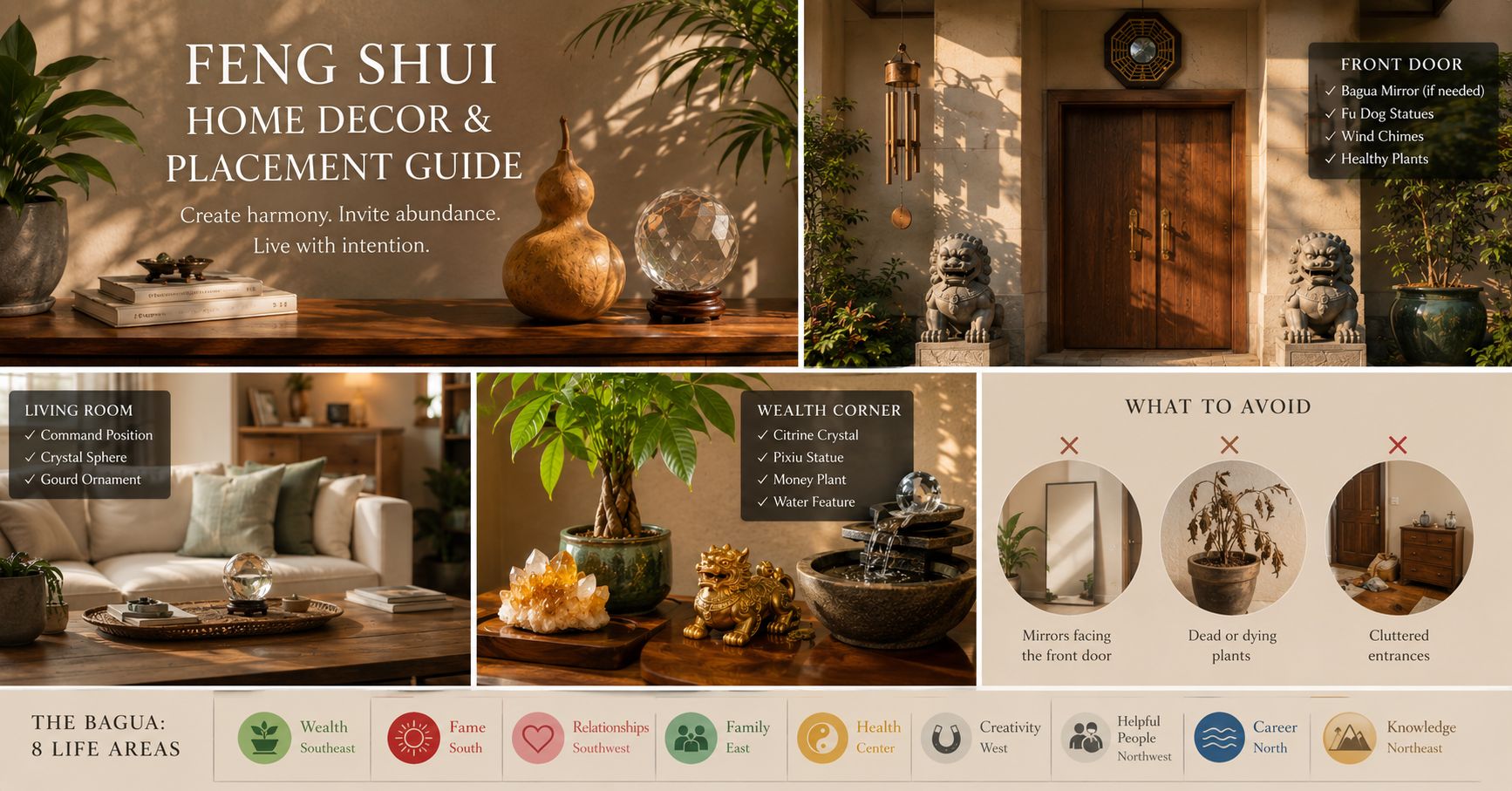
The Front Door: Your Home Mouth
In classical Feng Shui, the front door is called the "Mouth of Qi" (气口 / Qi Kou). It is where energy enters your home. Everything about the entrance matters: what you see when you approach, how the door opens, what you see immediately upon entering.
What to place near the front door:
- Bagua Mirror (八卦镜): Only if your door faces a direct threat — a T-intersection, a sharp roofline pointing at you, a hospital or cemetery directly across the street. The Bagua mirror deflects. Do not use one if you do not need one. Placing it casually is like carrying pepper spray at a dinner party — disproportionate and off-putting.
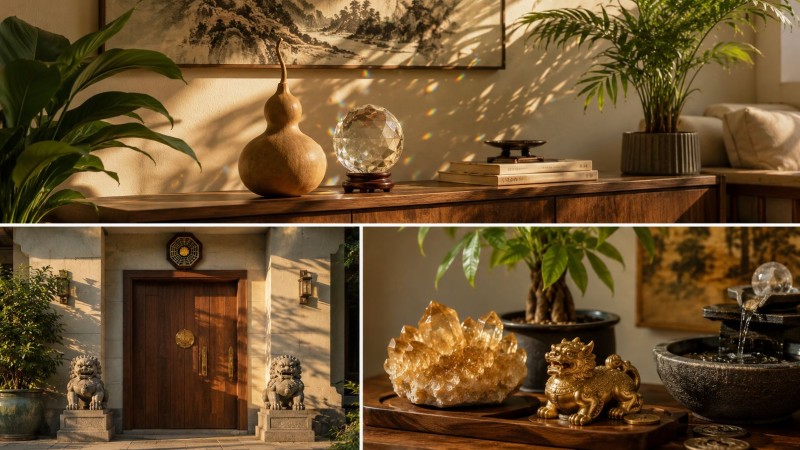
- Fu Dog Statues (石狮 / Shi Shi or 麒麟 / Qi Lin): Traditional guardian animals placed in pairs — male (with a ball under his paw, representing worldly protection) on the left as you face outward, female (with a cub under her paw, representing family protection) on the right. These are not subtle. They announce: this home is guarded.
- Wind Chimes (风铃 / Feng Ling): Metal wind chimes at the entrance are believed to "cut" and disperse harsh energy before it enters. Wood or bamboo chimes are gentler, used more for inviting positive energy than deflecting negative. The sound itself is the mechanism — sharp metallic tones for deflection, soft wooden tones for invitation.
- Healthy Plants: A pair of vibrant, healthy plants flanking the door is the simplest and most universally appropriate entrance treatment. They symbolize growth and welcoming life energy. Dead or dying plants at the entrance do the opposite — they signal stagnation. If you cannot keep a plant alive at your front door, remove it. A bare entrance is better than a dead one.
What to avoid: Mirrors directly facing the front door. In Feng Shui, a mirror facing the entrance bounces incoming energy right back out before it can circulate through the home. This is useful for deflecting something harmful but counterproductive for welcoming beneficial energy. If your entrance hallway has a mirror, angle it so it does not directly face the door.
The Living Room: Where Energy Settles
The living room is the heart of the home. Energy should settle here, not rush through. The most common problem in modern living rooms: furniture arranged to face screens rather than to face each other.
Key placements:
- Command Position: The main seating piece (usually the sofa) should have a solid wall behind it and a clear view of the room entrance. You should be able to see who enters without turning around. This is not superstition — it is basic human psychology. We are calmer when we can see potential threats (or guests) approaching.
- Crystal Spheres (水晶球 / Shui Jing Qiu): A clear quartz or rose quartz sphere placed on a side table or shelf in the living room is believed to harmonize energy. Faceted crystal spheres are particularly valued because they refract light — actual, physical light — scattering it into rainbows that shift throughout the day. The effect is genuinely pleasant regardless of what you believe about crystal energy.
- Gourd Ornaments (葫芦 / Hu Lu): The bottle gourd is one of the oldest Feng Shui symbols. Its shape — narrow at the top, wide at the bottom — represents heaven and earth united. In Taoist iconography, the gourd is the vessel that contains elixirs and captures negative energy. A natural dried gourd or a carved wooden gourd ornament placed in the living room is believed to absorb illness and misfortune. This is the item most commonly recommended by traditional Feng Shui consultants for homes where someone is recovering from illness.
The Wealth Corner: Southeast
This is where Feng Shui gets specific. Each direction of your home is associated with a different life area through the Bagua (Eight Trigrams) map. The southeast corner governs wealth and abundance.
To find your southeast corner: stand at the center of your home facing the front door. Use a compass app. The area in the southeast sector of your home (or, in Western Feng Shui, the far left corner from the entrance) is your wealth area.
What to place in the wealth corner:
- Citrine Cluster or Citrine Bracelet displayed as decor: Citrine is the universal wealth crystal. A piece of raw citrine or a citrine bracelet draped over a decorative stand keeps the wealth energy "active" and visible.
- Pixiu Statue (貔貅): A small Pixiu figurine facing the main entrance from within the wealth corner. Pixiu attracts and holds wealth. The figurine should face outward toward the room, not toward the wall.
- Money Plant (金钱树 / Jin Qian Shu or Pachira Aquatica): The braided trunk money tree with five leaves per stem (five represents the Five Elements in balance). Keep it healthy — yellow leaves in the wealth corner are considered a bad energetic sign.
- Water Feature: In Feng Shui, water represents the flow of money. A small tabletop fountain in the southeast corner is traditional. The water should flow TOWARD the interior of the home, not toward the door. But be practical — a fountain that you never clean is worse than no fountain at all. Stagnant water is stagnant wealth.
The Bedroom: Rest and Restoration
The bedroom rules in Feng Shui are stricter than any other room because this is where your body spends eight hours in its most vulnerable state — asleep.
Essential bedroom Feng Shui:
- Bed Position: Same command position principle — solid headboard against a wall, able to see the door without being directly in line with it (the "coffin position" — feet pointing directly at the door — is the worst placement).
- No Mirrors Facing the Bed: This rule is nearly universal across Chinese, Korean, and Vietnamese Feng Shui traditions. A mirror facing the bed is believed to bounce energy around the room while you sleep, preventing deep rest. Also, waking up and seeing your own reflection in the dark is genuinely startling, which is its own kind of sleep disruption.
- Remove Electronics: No television, no phone charger at the bedside, no Wi-Fi router in the bedroom. This is good Feng Shui AND good sleep hygiene. Electromagnetic fields aside, the blue light and notification anxiety from devices are well-documented sleep disruptors.
- Amethyst or Rose Quartz on the Nightstand: Gentle, calming stones for the bedroom. Amethyst for restful sleep. Rose quartz for emotional comfort. Do not place protective stones like obsidian or cinnabar in the bedroom — their energy is too active for a resting space.
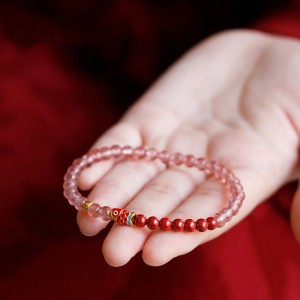
- Sandalwood Beads or Incense Holder: If you use a sandalwood bracelet, the bedroom is a good place to keep it when not wearing it. The subtle woody scent is calming, and sandalwood is associated with spiritual rest and Shen (神 / spirit) calming in traditional Chinese practice.
Home Office: Where Work Meets Energy
If you work from home, your desk placement matters more than any ornament.
Desk placement rules:
- Command position again: back to a solid wall, clear view of the door.
- Do not sit with your back to the door. If you must, place a small mirror on your desk so you can see who enters behind you.
- Keep the area under your desk clear. Stored boxes, tangled cables, and accumulated clutter under where you sit represent blocked career energy.
Desk items that help:
- Citrine or Pyrite: On the left side of your desk (wealth/abundance sector).
- Clear Quartz: Center of desk, for clarity and focus.
- Tiger Eye or Hematite: Right side of desk, for grounded decision-making and protection against bad deals or career missteps.
- Small Pixiu figurine: Facing the door, to attract wealth opportunities into your work.
Items You Should Probably Avoid
Not everything sold as "Feng Shui decor" is actually good Feng Shui. Here are common items I would skip:
- Dried flowers or preserved plants: Dead energy. Use living plants or high-quality artificial ones that look genuinely alive. A dusty plastic plant in the corner is worse than nothing.
- Aggressive imagery: Paintings of storms, shipwrecks, battle scenes, or predatory animals. Your walls are a constant visual input. What they depict seeps into your subconscious.
- Broken objects: If something is broken, fix it or remove it. A cracked vase or a clock that has stopped at 3:17 for six months is not "decor" — it is a signal of neglect.
- Too many mirrors: Mirrors activate and multiply energy. One well-placed mirror is better than five scattered around. A home that feels like a funhouse mirror maze is energetically chaotic.
- Clutter disguised as "collections": Be honest with yourself. If every surface in a room is covered with objects, energy cannot flow. Feng Shui is, at its core, about flow. Clutter is the opposite of flow.
Start Small
You do not need to Feng Shui your entire home in one weekend. That way lies overwhelm and a credit card bill full of crystal spheres.
Do three things, in this order:
- Clear the front entrance. Sweep it. Remove dead plants. Make sure the door opens fully without obstruction. This alone shifts the energy of your home more than any ornament.
- Fix your bed position. Solid headboard against a wall. Clear view of door. No mirror facing the bed. This costs nothing and affects eight hours of every day.
- Place one meaningful item. Not twenty. One. A gourd in the living room. A citrine in the wealth corner. A Pixiu on your desk. One thing you will actually see and care about. The point is intention, not inventory.
Explore Feng Shui Home Items: Browse Feng Shui Home Decor → | Lightning-Struck Wood Ornaments →