


Debunking the Myth
In popular folk belief, Buddhism is often closely associated with “exorcism”: wearing prayer beads, posting Buddha statues, and worshipping Bodhisattvas are regarded by many as ways to ward off evil spirits and bad luck. When encountering misfortune or setbacks, people often murmur, “Please Buddha and Bodhisattvas to ward off evil,” and some even spend money to invite monks to “perform rituals to drive away evil.” But few people know that this is a profound misunderstanding of Buddhism — Buddhism has never taught the concept of “exorcism” from beginning to end. The so-called “Buddhist exorcism” is nothing more than folk people forcibly grafting the secular needs of praying for blessings and warding off disasters onto Buddhist teachings, confusing the essence of faith with secular utilitarian demands, and ultimately reducing it to a superstitious interpretation that deviates from the core of the Dharma.
To understand this, we first need to clarify: the core of Buddhism is “liberation,” not “avoiding danger”; it is “cultivating the mind,” not “suppressing evil spirits.” Unlike Taoism, which has a clear theoretical system of “resolving negative energy and driving away evil spirits,” Buddhism has never taken “resisting evil spirits and blocking negative energy” as the core of its teachings since its birth, nor is there any classic record that “Buddhas and Bodhisattvas can ward off evil, or that the Dharma can drive away evil spirits.” The prayer beads, Buddha statues, and scriptures that people regard as “exorcism tools” are essentially aids to practice, not “amulets”; the scripture recitation and offerings that are misinterpreted as “exorcism rituals” focus on purifying the mind, not “driving away evil creatures.”
I. The Root of Misunderstanding: Grafting Secular Needs onto Buddhism, Confusing Faith with Superstition
The reason why the wrong perception of “Buddhist exorcism” has formed among the people is essentially that the secular need for “seeking good fortune and avoiding misfortune” is forcibly applied to Buddhist teachings. Coupled with long-term cultural integration and communication deviations, a deep-rooted misunderstanding has finally formed. This misunderstanding mainly stems from three aspects:
First, confusing the essential difference between “Buddhist protection” and “exorcism.” In Buddhism, there is indeed the karmic theory of “good deeds bring good rewards, and evil deeds bring evil retributions,” as well as the saying that “practitioners who hold compassion and correct mindfulness can stay away from troubles and disasters,” but this is not “exorcism.” The “protection” spoken of in the Dharma is the purification of the inner mind — when a person holds good thoughts, adheres to correct mindfulness, does not commit evil deeds, and does not generate evil thoughts, they will naturally stay away from conflicts and disasters. This is the natural manifestation of karma, not Buddhas and Bodhisattvas “performing rituals to ward off evil.” Just as the Five Precepts of Buddhism advocate: “Abstain from all evil, practice all good, and purify your mind — this is the teaching of all Buddhas.” Its core is to avoid planting evil causes by regulating one’s body, speech, and mind, thereby staying away from evil fruits, rather than “resisting evil spirits” through certain rituals.
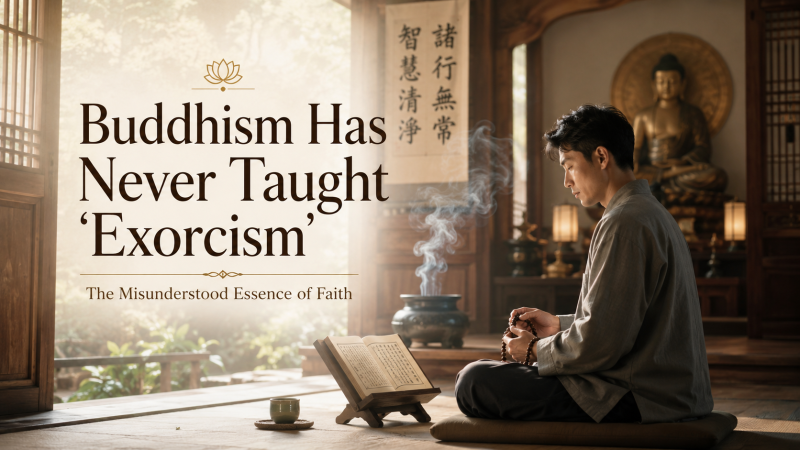
Second, secularizing and utilitarianizing Buddhist Dharma tools and rituals. The original purpose of prayer beads is a tool for counting and reminding oneself of correct mindfulness during practice; each bead represents “awareness and diligence,” not a “magic treasure to ward off evil.” The significance of Buddha statues is to worship and pay homage, reminding oneself to take the Buddha as an example and cultivate the mind to do good, not a “decorative item to protect the home and ward off evil.” The purpose of reciting scriptures is to comprehend the wisdom of the Dharma, calm and clear one’s mind, not “driving away evil by reciting mantras.” However, in secular dissemination, these practice tools have been given a utilitarian attribute of “exorcism.” People only pursue the superficial effect of “wearing = peace, reciting scriptures = driving away evil,” but ignore the core of the Dharma of “seeking inward.” Even if there are folk sayings such as “circumambulating a stupa to eliminate disasters” and “reciting scriptures and transferring merits to avoid misfortune,” their essence is to accumulate merits and purify karmic obstacles through worship and practice, not “exorcism.” This is the natural manifestation of the power of merits, not a supernatural “exorcism spell.”
Third, conceptual confusion in cultural integration. Throughout history, Buddhism has integrated with local folk beliefs and Taoist culture. Many people confuse Taoism’s theories of “resolving negative energy and driving away evil spirits” with Buddhism’s concepts of “protection and practice.” Taoism has clear theories about negative energy and evil spirits, as well as corresponding methods to resolve and drive them away. However, the core of Buddhism is “dependent origination and emptiness,” which fundamentally does not recognize the existence of independent “evil spirits” or “negative energy” — all disasters and misfortunes in the world are essentially manifestations of “karma,” the result of the combination of causes and conditions, not “the work of evil creatures.” Just as Buddhism views natural and man-made disasters as the result of collective and individual karma, a natural phenomenon of the aggregation of causes and conditions, not “caused by evil spirits,” so there is no need for “exorcism.”
II. The Core of Buddhism: No “Evil” to Ward Off, Only the “Mind” to Cultivate
The core teachings of Buddhism are “dependent origination and emptiness” and “karmic cause and effect.” From these two cores, we can clearly understand why Buddhism has no concept of “exorcism.”
First, Buddhism holds that “there is no evil to ward off.” In the Buddhist cosmology, all things in the world arise from the combination of causes and conditions; there is no eternal entity, nor are there independently existing “evil spirits” or “negative energy.” The so-called “evil” is essentially the three poisons of “greed, anger, and ignorance” in people’s hearts, a loss and deviation of the mind. When a person is filled with greed, anger, and ignorance, they will commit evil deeds, and then encounter misfortunes and disasters; on the contrary, when a person holds compassion, correct mindfulness, and wisdom, they can stay away from evil deeds and gain peace and smoothness. In other words, there is essentially no “evil” to ward off in the world. The “evil spirits” and “negative energy” we fear are nothing but projections of our own evil thoughts — a correct mind will not be disturbed by “evil”; a chaotic mind will see “evil” everywhere. As Buddhism says, “All phenomena arise from the mind.” If there is evil in your heart, you will attract evil circumstances; if there is good in your heart, you will attract good causes and conditions. The so-called “exorcism” is just an external manifestation of cultivating the mind.
Second, the core of Buddhism is “cultivating the mind,” not “avoiding disasters.” Buddhism holds that the root of human suffering and disasters lies in “attachment” and “ignorance” — clinging to gains and losses, clinging to blessings and misfortunes, clinging to the self, and being blinded by ignorance, which leads to fear and anxiety, and then the desire to “ward off evil” to escape disasters. The purpose of the Dharma is to guide people to eliminate ignorance, let go of attachments, purify the three poisons in the heart through practice, and ultimately get rid of the suffering of samsara and reach the state of nirvana. The process of practice is to correct one’s words and deeds, purify one’s heart, not “asking Buddhas and Bodhisattvas to protect oneself and drive away evil spirits.” Even if some people feel “peace and smoothness” during practice, it is not the effect of “exorcism,” but because after the mind is purified, karma turns towards good, and causes and conditions become peaceful. This is the natural result of practice, not supernatural “blessing.”
More importantly, Buddhism opposes “utilitarian faith” and even more opposes deifying and instrumentalizing Buddhas and Bodhisattvas. The essence of Buddhas and Bodhisattvas is “enlightened ones” — through practice, they eliminated ignorance, reached a state of perfection, and became role models for people’s practice. Buddhism advocates that people “learn from the Buddha,” not “pray to the Buddha”; it advocates that people “liberate themselves,” not “rely on Buddhas and Bodhisattvas to liberate themselves.” The so-called “Buddhas save those who are destined” does not mean that Buddhas and Bodhisattvas take the initiative to “ward off evil and protect,” but that those who are destined are willing to listen to the teachings of the Dharma, cultivate their minds to do good, and thus stay away from disasters and gain peace. The behavior of “spending money to invite Buddhas and burn incense to ward off evil” is essentially treating Buddhas and Bodhisattvas as “objects of transaction,” which is a desecration of the Dharma and runs counter to the core teachings of Buddhism. Just as Buddhism emphasizes that “karma spans three lifetimes,” all blessings and misfortunes are the fruits of one’s own karma. Only by doing good deeds and practicing can one change karma, not escape karma through “exorcism.”
III. Those Misunderstood “Buddhist Exorcism” Practices Are Actually Aids to Practice
The so-called “Buddhist exorcism” methods we often hear are actually misunderstood practice methods. Their essence has nothing to do with “exorcism,” but are aids to help people cultivate their minds and purify their karma, which are only given a utilitarian “exorcism” label by the secular world:
1. Wearing prayer beads: Not “exorcism,” but a reminder of “correct mindfulness.” Every rotation of the prayer beads is an act of awareness, reminding oneself to let go of distracting thoughts, hold good thoughts, and not be troubled by greed, anger, and ignorance. Its significance is a “tool” for practice, not a “magic treasure to ward off evil.” For example, people in the folk believe that glazed glass, one of the Seven Treasures of Buddhism, can “eliminate disasters and ward off evil.” In fact, the characteristic of glazed glass — “transparent inside and out, pure and flawless” — symbolizes the pure state of mind of practitioners. The essence of its “disaster elimination” is the natural result of a purified mind, not that glazed glass itself has the power to “ward off evil.”
2. Reciting scriptures and Buddha’s name: Not “driving away evil,” but purifying the mind and accumulating good karma. The purpose of reciting scriptures is to comprehend the wisdom of the Dharma, make one’s mind calm and clear, and eliminate ignorance and attachment; the purpose of reciting the Buddha’s name is to rely on the Buddha’s vows, remind oneself to learn from the Buddha, and cultivate the mind to do good. Long-term recitation of scriptures and the Buddha’s name will make people’s mentality peaceful, their words and deeds kind, and thus stay away from conflicts and disasters. But this is not “driving away evil,” but the natural reward of accumulating good karma. Even Buddhist Dharma assemblies and scripture recitation with merit transfer aim to transcend the deceased, resolve karmic knots, and purify karmic obstacles, not “driving away evil.” They are to help all sentient beings get rid of suffering, not “block evil spirits.”
3. Worshiping Buddha statues: Not “protecting the home and warding off evil,” but expressing respect and setting an example. Worshiping Buddha statues is to pay homage to the Buddha’s dignity, remind oneself to take the Buddha as an example, and practice compassion, wisdom, and correct mindfulness, not to pray to the Buddha statue to “ward off evil.” The Buddha statue itself has no power to “ward off evil”; its significance is a “guide” on the path of practice, not a “shrine for protection.” As a pure practice place, a temple is believed to make people feel peaceful, not because it can “ward off evil,” but because the pure atmosphere of the temple can help people calm their minds and stay away from the hustle and bustle. This is the impact of the environment on the mind, not supernatural “exorcism power.”
IV. Conclusion: Letting Go of the Obsession with “Exorcism” Is the True Faith
The reason why secular people are obsessed with “Buddhist exorcism” is essentially due to inner fear and utilitarianism — fearing disasters and longing for smoothness, but being unwilling to start from themselves to cultivate their minds and do good. Instead, they pin their hopes on “exorcism” rituals and tools, mistakenly believing that as long as they wear prayer beads and recite scriptures, they can “ward off evil spirits and bad luck” once and for all. But this is precisely contrary to the core of Buddhism: the Dharma never promises “exorcism” nor “no disasters.” It only tells us: all disasters and misfortunes are manifestations of karma. Only by cultivating the mind, doing good deeds, and letting go of attachments can we fundamentally stay away from suffering and gain peace.
Buddhism has no concept of “exorcism” because it never teaches us to “escape,” but only to “face” — to face our own hearts, face our own karma, and through practice, purify our minds, eliminate ignorance, and ultimately get rid of fear and attachment, achieving inner perfection and liberation. The tools and rituals we regard as “exorcism” are only aids on the path of practice. What can truly “protect” us is never Buddhas and Bodhisattvas, nor prayer beads and Buddha statues, but our own good thoughts, correct mindfulness, and practice.
True Buddhist faith is not utilitarianly praying to “ward off evil and bad luck,” but letting go of obsessions, cultivating the mind to do good, and adhering to compassion and correct mindfulness in every word and deed; it is not relying on external “magic treasures,” but relying on one’s own practice to change karma and gain smoothness. When we let go of the obsession with “exorcism” and truly understand the core of the Dharma of “seeking inward,” we can truly enter the essence of faith and gain inner peace and liberation — this is the true wisdom that Buddhism wants to convey to us.
Quick Answer
Does Buddhism really teach exorcism? Explore the misunderstood idea of Buddhist protection, the true meaning of prayer beads and rituals, and how Buddhism differs from Taoist protection traditions.
Questions This Guide Answers
- What does Buddhism Has Never Taught “Exorcism” — The Misunderstood Essence of Faith mean in Taoist, Feng Shui, or modern spiritual culture?
- How can readers understand protection jewelry, amulets, talismans, charms, luck rituals, or symbolic objects without treating them as guaranteed outcomes?
- How does this idea connect to personal intention, cultural meaning, and everyday mindful practice?
Reader Note
Seer articles explain cultural symbolism and spiritual traditions for general learning. They are not medical, financial, or legal advice.
Leave a comment